The paradigm of software development is shifting rapidly with the advancement of generative AI. We are moving beyond simple code recommendations or generation toward "AI Coding Agents"—systems capable of understanding a developer's intent and utilizing necessary tools to autonomously execute a complete development workflow, from code analysis to modification and testing, thereby reducing the developer's burden and enhancing productivity.
Recognizing this shift, Samsung Semiconductor developed 'Code Mate,' an in-house AI Coding Agent designed to leverage AI coding technology within an environment that strictly adheres to internal security policies. Since its implementation in 2023, Code Mate has been supporting a diverse range of tasks in the semiconductor software development field, contributing significantly to increased development productivity.
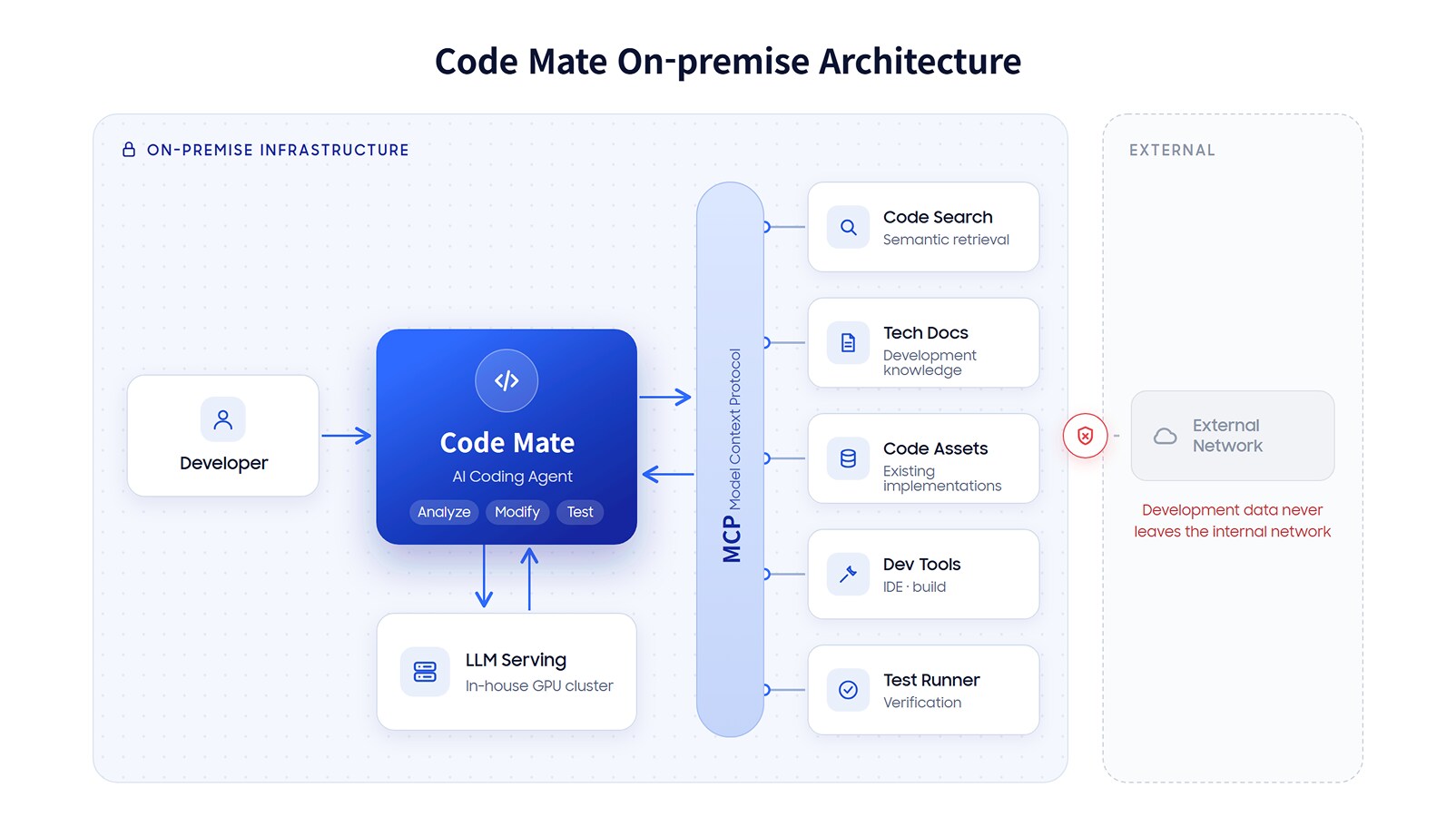
Applying an AI Coding Agent to the semiconductor development field requires more than just high coding performance; it necessitates a deep consideration of the specificities of the security and development environment. Semiconductor facility and process software development rely on vast codebases and specialized domain knowledge accumulated over long periods, and general-purpose AI models often struggle to sufficiently grasp internal coding conventions or specific implementation patterns.
To address this, Code Mate was built using an On-premise architecture, where AI models and services are operated on internal infrastructure, ensuring that development data is never transmitted externally. Alongside this, we have advanced the technologies necessary for the AI Coding Agent to effectively utilize the code and specialized knowledge required for semiconductor development.
In semiconductor software development, it is essential to synthesize various contexts, including existing implementation cases and development documentation, rather than focusing solely on the code currently being written. To this end, we have conducted research on the ‘Semantic Code Finder,’ which locates relevant code based on semantic similarity beyond simple keyword searches, and ‘Find My Code Twin,’ which explores similar implementation patterns using LLMs [1][2]. These search technologies serve as the foundation for securing the ‘Development Context’—the necessary code and technical knowledge required for a development task.
The 'Model Context Protocol (MCP)' is responsible for linking this secured Development Context so that the AI Coding Agent can utilize it in actual tasks. MCP is a technology that enables AI models to access internal data sources and tools in a standardized manner. Code Mate leverages this protocol to integrate relevant code, technical documents, and development expertise into the task execution process [3].
For example, when a developer requests a solution to a problem, Code Mate uses MCP-linked search tools to explore related technical documents and similar implementation cases. Based on the retrieved information, it analyzes and modifies the code, then verifies the results through development tools and testing. In this way, Code Mate contributes to the productivity of semiconductor software development by connecting internal code assets and technical knowledge to actual development tasks while maintaining a secure environment.
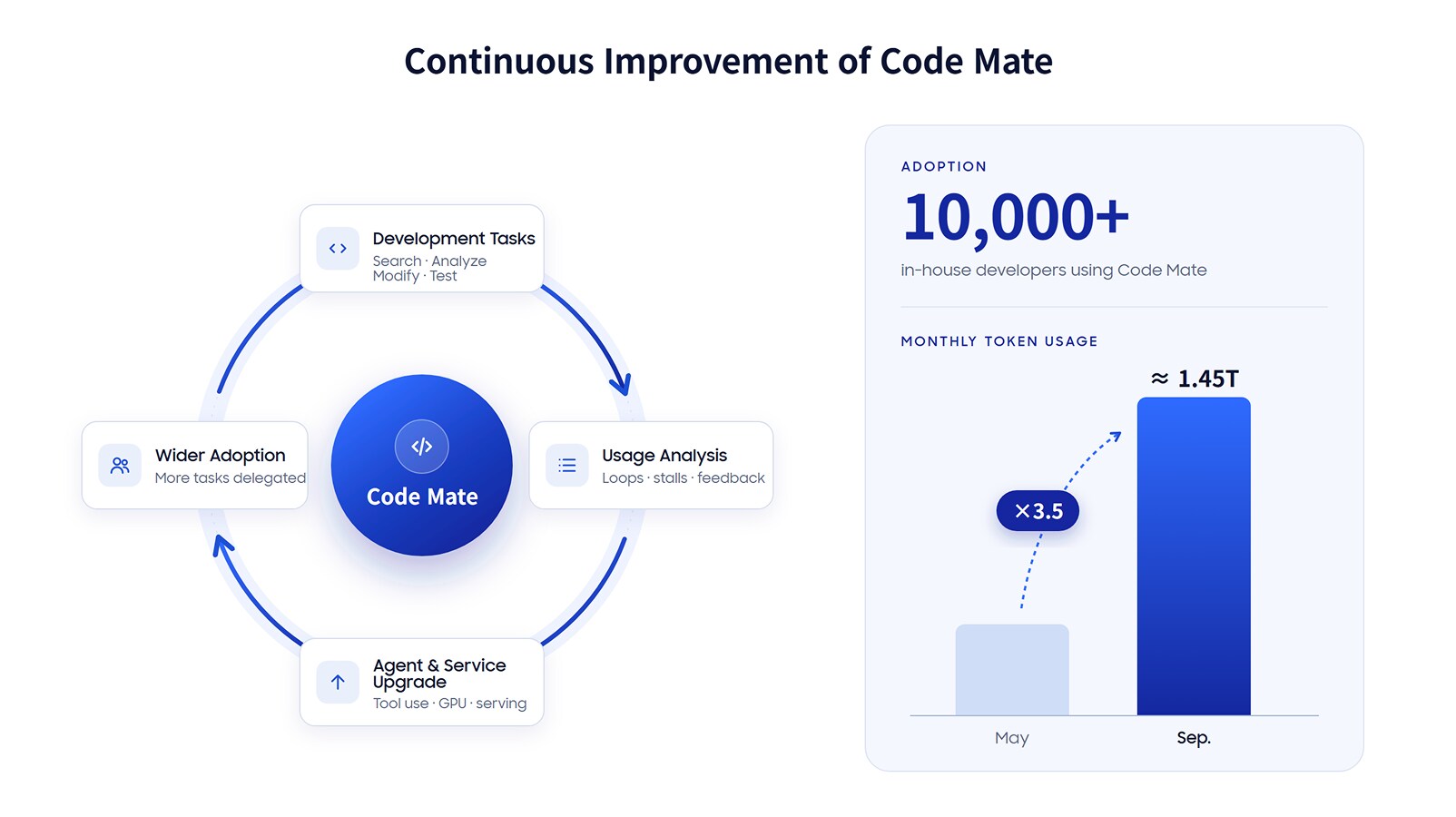
Code Mate continuously improves its performance based on actual tasks and user experiences encountered during semiconductor software development. AI Coding Agents utilize various tools during the process of code exploration, root cause analysis, modification, and verification, adjusting their approach based on the execution results. We analyze the causes of repetitive exploration or task interruptions, as well as the most effective development contexts and tool usage patterns, and reflect these insights directly into the Agent's performance enhancements.
Beyond task execution capabilities, the service speed and stability perceived by the user are critical areas for improvement. To reduce response latency caused by an increasing user base, we are continuously expanding GPU resources and optimizing the AI model serving environment to provide stable service even during peak usage hours. Through this approach, we are simultaneously enhancing both the Agent's performance and the overall quality of the service based on field experience and user feedback.
Along with these efforts, the adoption of Code Mate is expanding. Code Mate has now become a staple AI Coding Agent utilized by over 10,000 developers internally, with monthly token usage increasing approximately 3.5 times compared to May, when adoption accelerated, reaching approximately 1.45 trillion tokens as of September. As the use of Code Mate expands, AI Coding Agents are being applied to a wider variety of software development tasks, and this is expected to further enhance development productivity.
Practical work patterns are also shifting. Feedback from the field includes positive evaluations such as, “Tasks that previously took 3 to 4 days can now be completed in a single day,” and “The faster response times and ability to handle long-duration tasks without interruption have allowed me to delegate more development work to the AI.” Code Mate is evolving to reduce the burden of repetitive code exploration and modification, allowing developers to focus on more critical design and problem-solving tasks.
Moving forward, the goal for Code Mate is to evolve beyond handling one-off requests to becoming an AI Coding Agent capable of maintaining context across the entire development lifecycle to execute more complex and prolonged development tasks.
To achieve this, we are improving AI model performance while strengthening the Agent's ability to accurately explore development contexts, utilize appropriate tools, and execute multi-step tasks sequentially. We are also enhancing the system to stably execute long-term development tasks by reusing context and experience accumulated from previous steps at the appropriate time. In the future, we plan to establish an evaluation environment based on actual development tasks to continuously measure and improve the capabilities required for development work.
By organically linking internal technical assets and development experience, Samsung Semiconductor is building a virtuous cycle where field experience directly drives the performance of the AI Coding Agent. This will create an environment where developers can focus on solving more complex and critical problems, and we expect that the resulting increase in semiconductor software development productivity will ultimately strengthen the product competitiveness of Samsung Semiconductor.

 Global
