Anyone who has spent time gaming on a smartphone knows the frustration: the battery drains quickly, or frame rates drop at critical moments. High graphical fidelity and smooth frame rates are both essential, but achieving both simultaneously is no easy task given the power and thermal constraints inherent to mobile devices.
AI has emerged as a compelling solution to this challenge. On PCs, AI upscaling technology is already widely adopted, powering hundreds of games, and its role has expanded well beyond resolution enhancement to encompass frame generation and broader rendering optimization across the graphics pipeline. This shift is now rapidly extending into the mobile space.
In step with this trend, Samsung has developed ENSS™ (Exynos Neural Super Sampling), a GPU-based AI graphics technology designed to deliver high graphical quality and power efficiency simultaneously on mobile devices. ENSS™ is the industry's first commercial AI graphics technology to implement both NSS (Neural Super Sampling), an AI upscaling technology, and NFG (Neural Frame Generation), an AI frame generation technology, together on a mobile GPU.
ENSS™ consists of two core AI technologies. NSS reconstructs high-resolution images from frames rendered at lower resolutions, while NFG generates entirely new intermediate frames between two rendered frames. Together, these technologies enhance both image quality and rendering smoothness while minimizing GPU workload.
Neural Super Sampling (NSS)
Upscaling technologies have evolved from spatial and temporal approaches to AI-based methods. Spatial upscaling increases image resolution using only information from the current frame. While computationally efficient and relatively simple to implement, its ability to restore fine details is limited. To address these limitations, temporal upscaling emerged, leveraging not only the current frame but also information from previous frames and motion vectors to deliver higher image quality than spatial approaches.
However, because both methods reconstruct images based on predefined algorithms, they remain susceptible to artifacts such as ghosting¹, flickering², and shimmering³, particularly in scenes with fast motion or complex visual content. To overcome these limitations, AI-based upscaling was introduced. By utilizing neural networks trained on large-scale datasets covering diverse scene characteristics, AI-based upscaling reconstructs images according to the characteristics of each scene, delivering more natural image quality while effectively reducing artifacts.
NSS brings this AI-based upscaling to the mobile GPU environment. By reconstructing low-resolution frames rendered by the GPU into high-resolution images using AI, NSS reduces the GPU's rendering workload while simultaneously delivering high image quality and power efficiency. For example, a frame rendered by the GPU at 540p can be reconstructed by AI to achieve image quality comparable to 1080p.
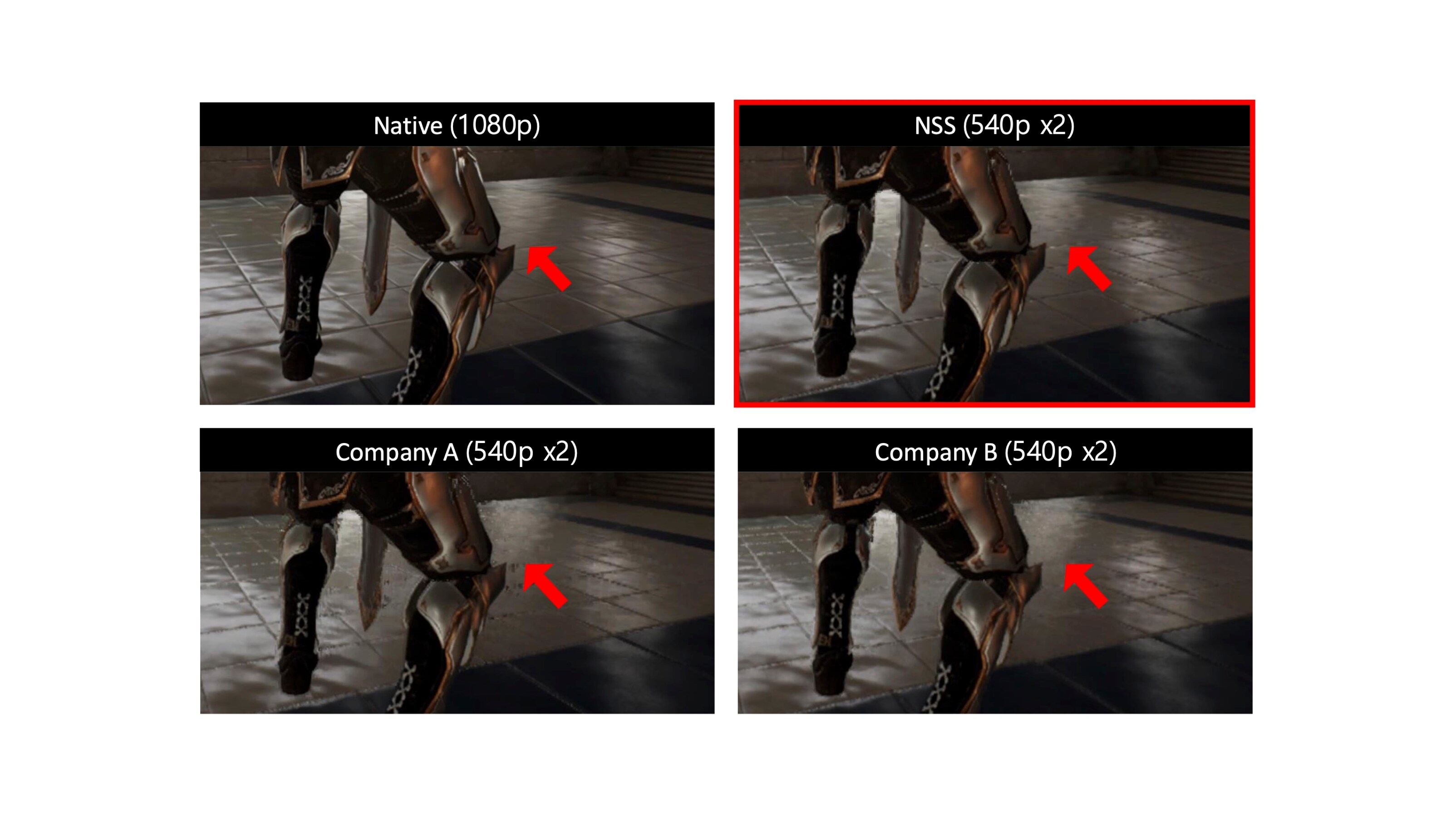
At the core of NSS is an ultra-lightweight AI model built on a kernel prediction architecture. Unlike conventional super-resolution models that directly generate high-resolution pixels, the model predicts reconstruction kernels for each pixel location and restores the final image by combining weighted pixel information from both the current and previous frames. This architecture is designed to significantly reduce model parameters and computational overhead while delivering industry-leading image quality in 2x upscaling scenarios.
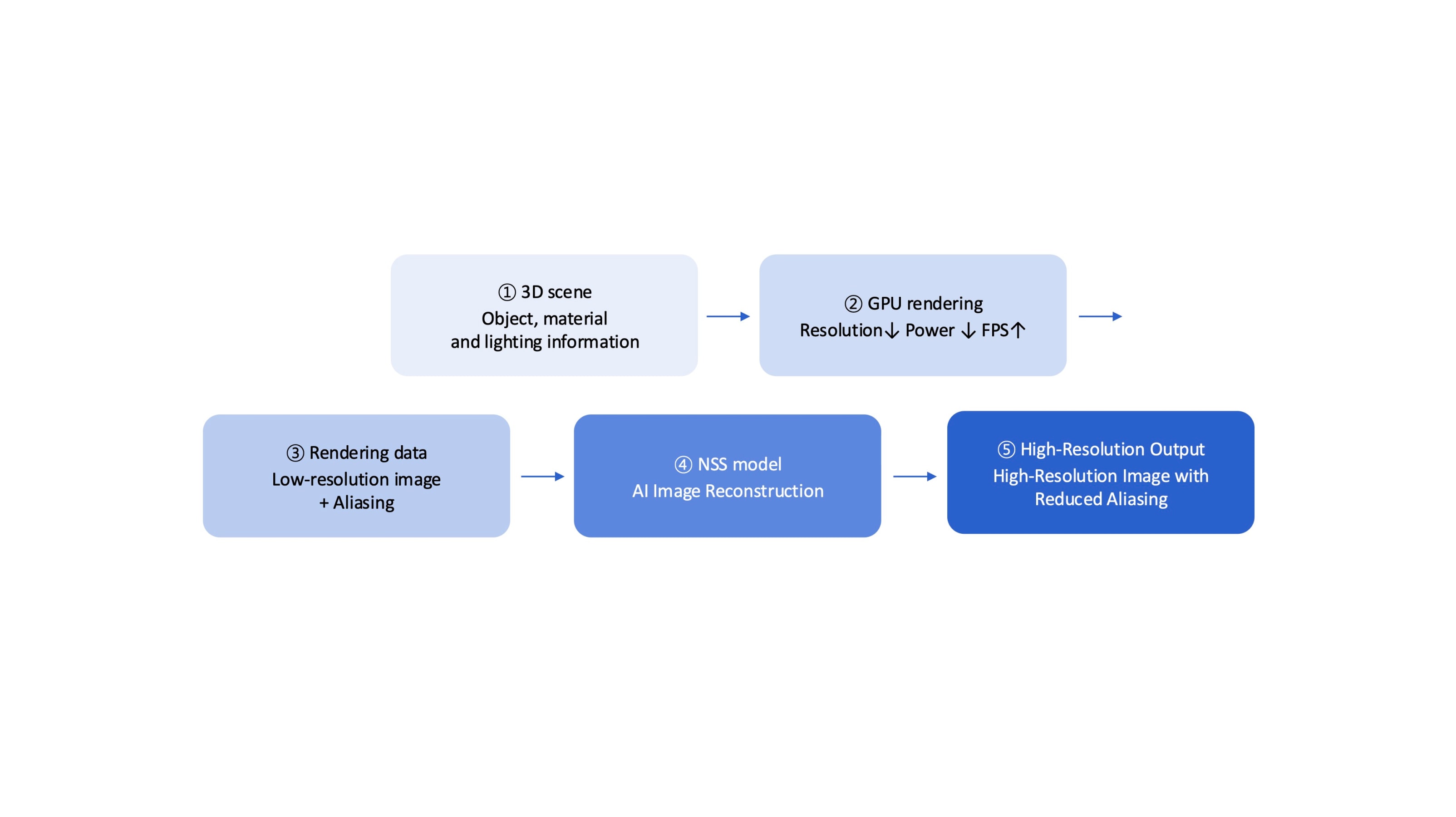
The NSS pipeline consists of five stages. First, the GPU renders the 3D scene at a lower resolution while generating auxiliary information such as color, depth, and motion vectors. The AI model then combines these inputs with data from the previous frame to reconstruct lost details while minimizing visual artifacts such as flickering and ghosting. Finally, the reconstructed high-resolution frame is generated with reduced aliasing and more natural image quality.
Neural Frame Generation (NFG)
Frame generation is a technology that creates new frames between rendered frames to increase FPS and deliver a smoother visual experience. It has evolved from frame interpolation to non-AI-based frame generation, and more recently, AI-based frame generation.
Frame interpolation generates intermediate frames by estimating object motion between the previous and current frames using only the frames rendered by the GPU as input. While relatively simple to implement, it is prone to artifacts such as ghosting, particularly in scenes with fast motion or complex visual content.
The next stage of evolution was non-AI-based frame generation, which synthesizes new frames using rendering information generated by the game engine, such as motion vectors and color buffers. By leveraging more accurate motion information than frame interpolation, it improves frame quality. However, because it still relies on predefined algorithms, it remains limited in handling complex scenes or nonlinear motion.
In contrast, AI-based frame generation uses neural networks that take rendering information, including motion vectors and color buffers, as input to generate new frames. Trained on large-scale datasets containing diverse scenes and motion patterns, AI can generate more natural-looking frames while effectively reducing artifacts such as ghosting and flickering compared with conventional algorithm-based approaches.
NFG adapts this AI-based frame generation approach for mobile GPUs. Designed for real-time execution on mobile GPUs, NFG enables AI to generate intermediate frames between two rendered frames without requiring the GPU to render additional frames, delivering a more fluid gaming experience while minimizing rendering overhead.
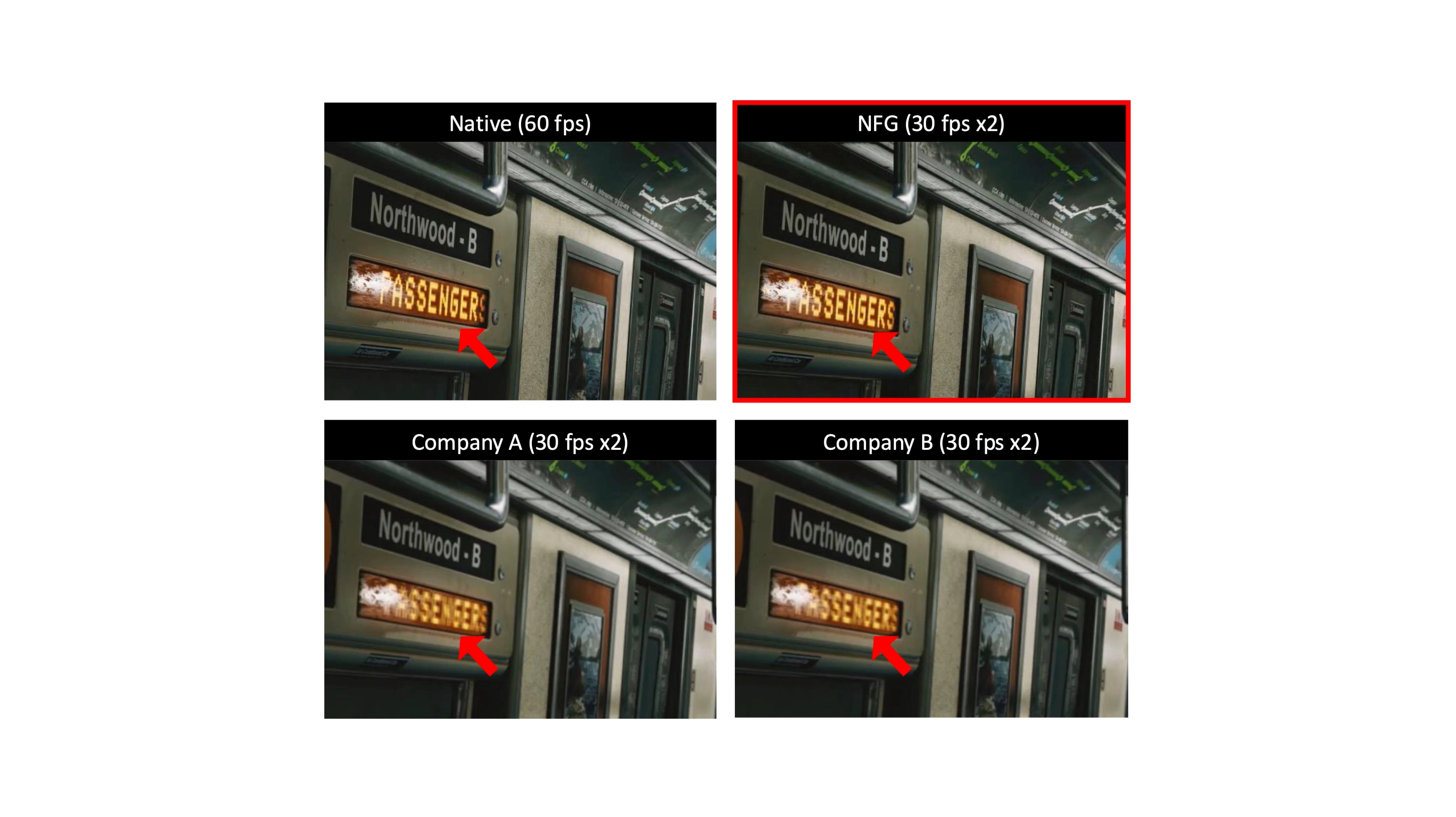
The key innovation behind NFG is the Shade Flow model. Conventional optical flow-based frame generation estimates motion primarily from object movement. In contrast, Shade Flow analyzes not only object motion but also changes in lighting, enabling accurate prediction of shading variations such as shadows and reflections. This allows NFG to generate more natural and stable intermediate frames even in scenes with subtle motion or rapidly changing illumination.
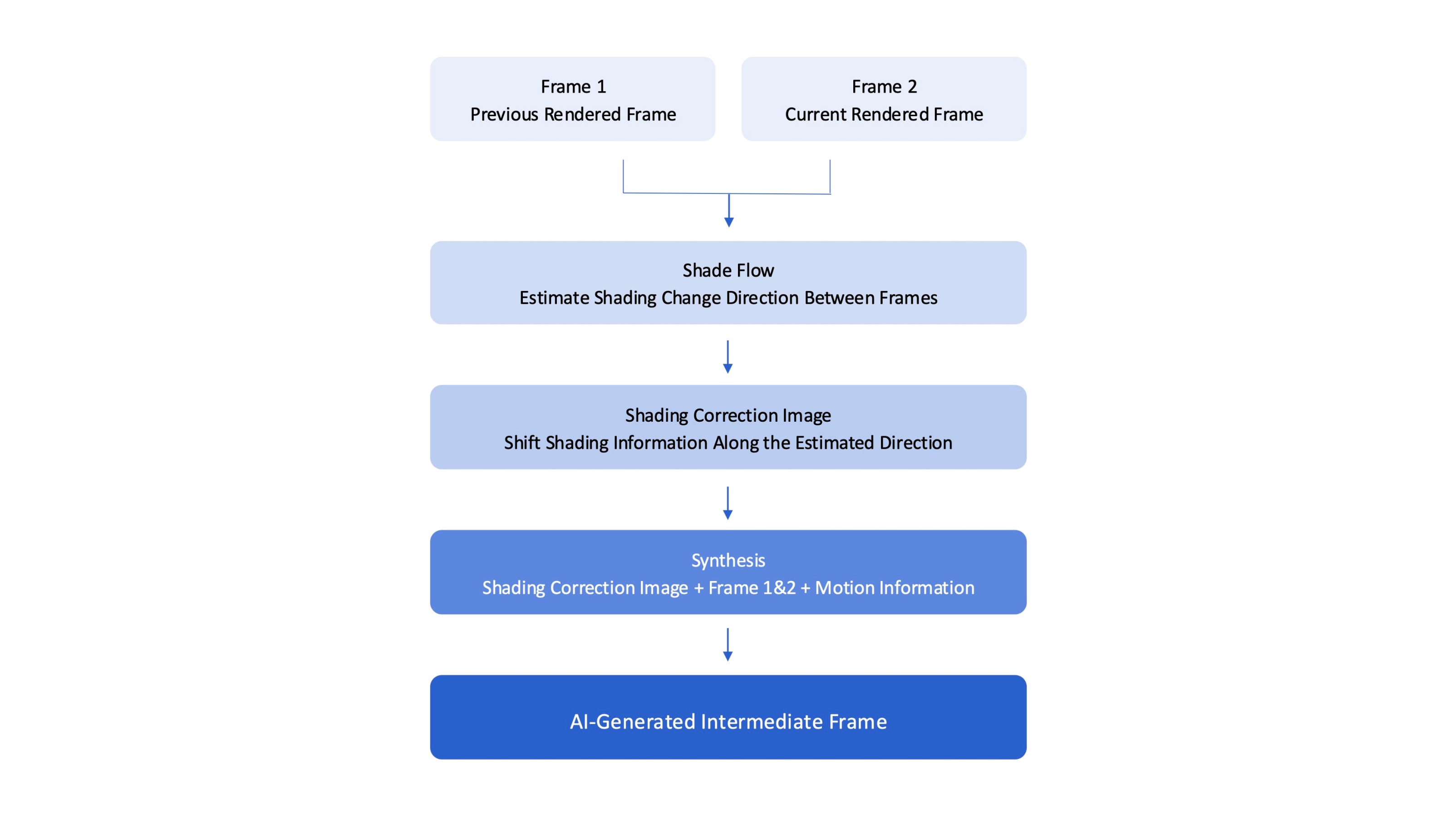
The NFG pipeline operates as follows. It begins by taking the previous and current rendered frames as inputs, predicting shading variations, and combining them with correction images to synthesize the final intermediate frame. These AI-generated frames are seamlessly inserted between every two rendered frames, improving temporal continuity and delivering a smoother gaming experience without imposing additional rendering demands on the GPU. By combining NSS and NFG, ENSS™ achieves an average FPS/W up to 3× higher under the same power conditions.⁴
Enabling real-time operation of ENSS™ demands not only high-performance AI models but also an efficient data pipeline. In conventional AI inference workflows, rendered frames must be copied from GPU memory to a dedicated inference buffer before AI processing can begin. This memory transfer introduces additional latency and power consumption.
To eliminate this bottleneck, Samsung developed a Vulkan-based AI inference framework featuring a Zero-Copy architecture. The framework enables GPU textures to be used directly as AI inference input buffers, allowing rendered frames to be processed without additional memory copies. It also natively supports game engines' native texture formats, allowing render buffers to be reused directly in GPU memory while minimizing unnecessary data transfers between the CPU/NPU and the GPU.
In addition, AI model weights are embedded directly into shader code and automatically integrated during the build process, reducing runtime loading overhead. Together, these optimizations minimize latency and frame interruptions during gameplay while enabling stable real-time AI graphics processing.
To simplify adoption, Samsung also provides plugins for major game engines, allowing developers to integrate ENSS™ into existing development environments with minimal effort.
The future of mobile graphics is no longer defined solely by GPU performance. Increasingly, it depends on how effectively AI can be integrated throughout the graphics pipeline.
ENSS™ represents a significant step toward that future by combining AI upscaling and AI frame generation in real time on a single mobile GPU, while also providing an optimized AI inference framework that simplifies adoption for developers. By advancing AI technologies across both hardware and software, Samsung will continue expanding the possibilities of next-generation mobile AI graphics.

 Global