
ENSS™ (Exynos Neural Super Sampling) is an AI-driven rendering optimization technology integrated into the Xclipse, the Exynos GPU.
In high-resolution and high-refresh-rate environments, rendering at native resolution requires intensive pixel shading, texture sampling, and lighting calculations, leading to a significant increase in computational workload and power consumption. To alleviate this structural burden, ENSS™ strategically lowers the internal rendering resolutions and combines NSS (Neural Super Sampling), an AI-based resolution reconstruction technology, with NFG (Neural Frame Generation), an AI-driven intermediate frame generation technology. Through this integrated architecture, ENSS™ balances computational efficiency and visual smoothness, making high-fidelity gaming experiences sustainable within strict mobile power constraints.
ENSS™ (Exynos Neural Super Sampling) is an AI-driven rendering optimization technology integrated into the Xclipse, the Exynos GPU.
In high-resolution and high-refresh-rate environments, rendering at native resolution requires intensive pixel shading, texture sampling, and lighting calculations, leading to a significant increase in computational workload and power consumption. To alleviate this structural burden, ENSS™ strategically lowers the internal rendering resolutions and combines NSS (Neural Super Sampling), an AI-based resolution reconstruction technology, with NFG (Neural Frame Generation), an AI-driven intermediate frame generation technology. Through this integrated architecture, ENSS™ balances computational efficiency and visual smoothness, making high-fidelity gaming experiences sustainable within strict mobile power constraints.
ENSS™ (Exynos Neural Super Sampling) is an AI-driven rendering optimization technology integrated into the Xclipse, the Exynos GPU.
In high-resolution and high-refresh-rate environments, rendering at native resolution requires intensive pixel shading, texture sampling, and lighting calculations, leading to a significant increase in computational workload and power consumption. To alleviate this structural burden, ENSS™ strategically lowers the internal rendering resolutions and combines NSS (Neural Super Sampling), an AI-based resolution reconstruction technology, with NFG (Neural Frame Generation), an AI-driven intermediate frame generation technology. Through this integrated architecture, ENSS™ balances computational efficiency and visual smoothness, making high-fidelity gaming experiences sustainable within strict mobile power constraints.

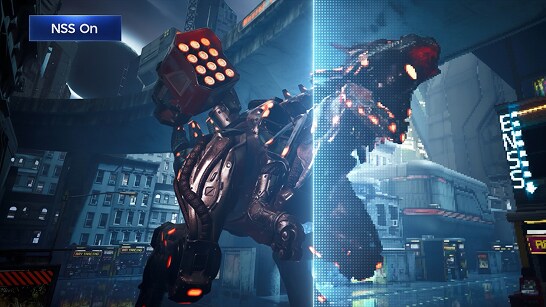
NSS (Neural Super Sampling) is an AI-based upscaling technology that reconstructs images rendered at a lower internal resolution to near-native visual quality.
In mobile environments, maintaining native resolution while enabling advanced graphical effects such as ray tracing significantly increases GPU load and power consumption. NSS reduces pixel processing demand by lowering the internal rendering resolution, while leveraging a trained neural network to precisely restore edge sharpness and texture detail through AI inference. This approach preserves ray tracing effects while delivering visual quality comparable to native resolution, enabling improved performance and smoother gameplay.
NSS (Neural Super Sampling) is an AI-based upscaling technology that reconstructs images rendered at a lower internal resolution to near-native visual quality.
In mobile environments, maintaining native resolution while enabling advanced graphical effects such as ray tracing significantly increases GPU load and power consumption. NSS reduces pixel processing demand by lowering the internal rendering resolution, while leveraging a trained neural network to precisely restore edge sharpness and texture detail through AI inference. This approach preserves ray tracing effects while delivering visual quality comparable to native resolution, enabling improved performance and smoother gameplay.
NSS (Neural Super Sampling) is an AI-based upscaling technology that reconstructs images rendered at a lower internal resolution to near-native visual quality.
In mobile environments, maintaining native resolution while enabling advanced graphical effects such as ray tracing significantly increases GPU load and power consumption. NSS reduces pixel processing demand by lowering the internal rendering resolution, while leveraging a trained neural network to precisely restore edge sharpness and texture detail through AI inference. This approach preserves ray tracing effects while delivering visual quality comparable to native resolution, enabling improved performance and smoother gameplay.
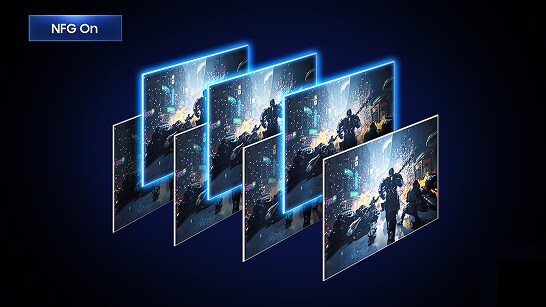
NFG (Neural Frame Generation) enhances FPS by generating AI-based intermediate frames between rendered frames.
It analyzes motion vectors and optical flow information between consecutive frames computed by the GPU. Based on temporal data, the neural network predicts object trajectories and scene transitions to generate new intermediate frames. Rather than duplicating existing frames, NFG reconstructs them with a comprehensive understanding of object-level motion and temporal continuity. This method minimizes distortion and ghosting during rapid camera movements or complex action scenes, ensuring stable visual consistency and enhanced smoothness without proportionally increasing rendering workload.
NFG (Neural Frame Generation) enhances FPS by generating AI-based intermediate frames between rendered frames.
It analyzes motion vectors and optical flow information between consecutive frames computed by the GPU. Based on temporal data, the neural network predicts object trajectories and scene transitions to generate new intermediate frames. Rather than duplicating existing frames, NFG reconstructs them with a comprehensive understanding of object-level motion and temporal continuity. This method minimizes distortion and ghosting during rapid camera movements or complex action scenes, ensuring stable visual consistency and enhanced smoothness without proportionally increasing rendering workload.
NFG (Neural Frame Generation) enhances FPS by generating AI-based intermediate frames between rendered frames.
It analyzes motion vectors and optical flow information between consecutive frames computed by the GPU. Based on temporal data, the neural network predicts object trajectories and scene transitions to generate new intermediate frames. Rather than duplicating existing frames, NFG reconstructs them with a comprehensive understanding of object-level motion and temporal continuity. This method minimizes distortion and ghosting during rapid camera movements or complex action scenes, ensuring stable visual consistency and enhanced smoothness without proportionally increasing rendering workload.


 Global