
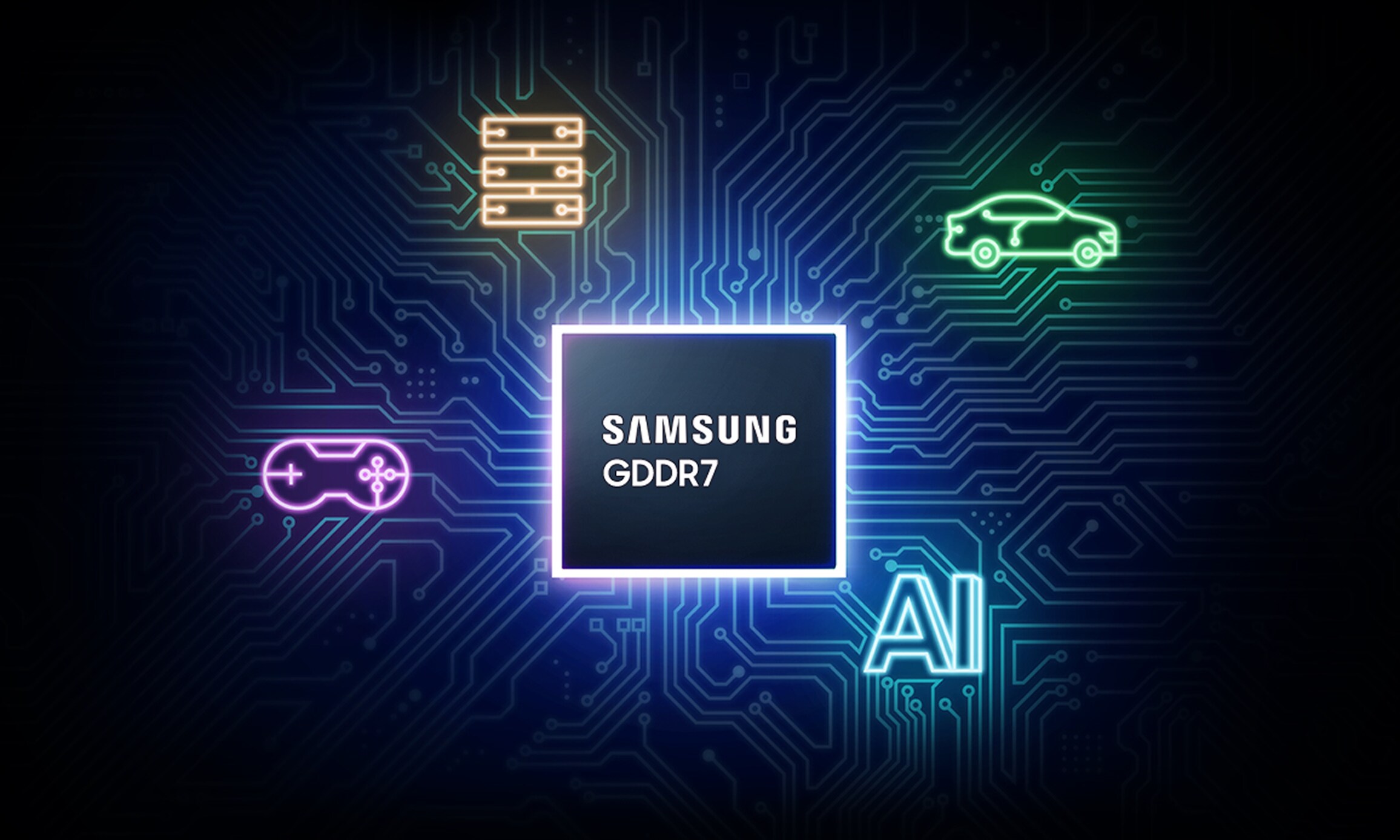
As the first DRAM to feature PAM3 signaling, GDDR7 represents a major step forward for graphics memory in the AI era. Compared to the previous generation GDDR71), it delivers up to 71% higher bandwidth, positioning GDDR7 as a high-performance graphics memory solution for
next-generation AI and accelerated computing workloads.
1) Comparison with the GDDR7 16Gb
As the first DRAM to feature PAM3 signaling, GDDR7 represents a major step forward for graphics memory in the AI era. Compared to the previous generation GDDR71), it delivers up to 71% higher bandwidth, positioning GDDR7 as a high-performance graphics memory solution for next-generation AI and accelerated computing workloads.
1) Comparison with the GDDR7 16Gb
As the first DRAM to feature PAM3 signaling, GDDR7 represents a major step forward for graphics memory in the AI era. Compared to the previous generation GDDR71), it delivers up to 71% higher bandwidth, positioning GDDR7 as a high-performance graphics memory solution for next-generation AI and accelerated computing workloads.
1) Comparison with the GDDR7 16Gb
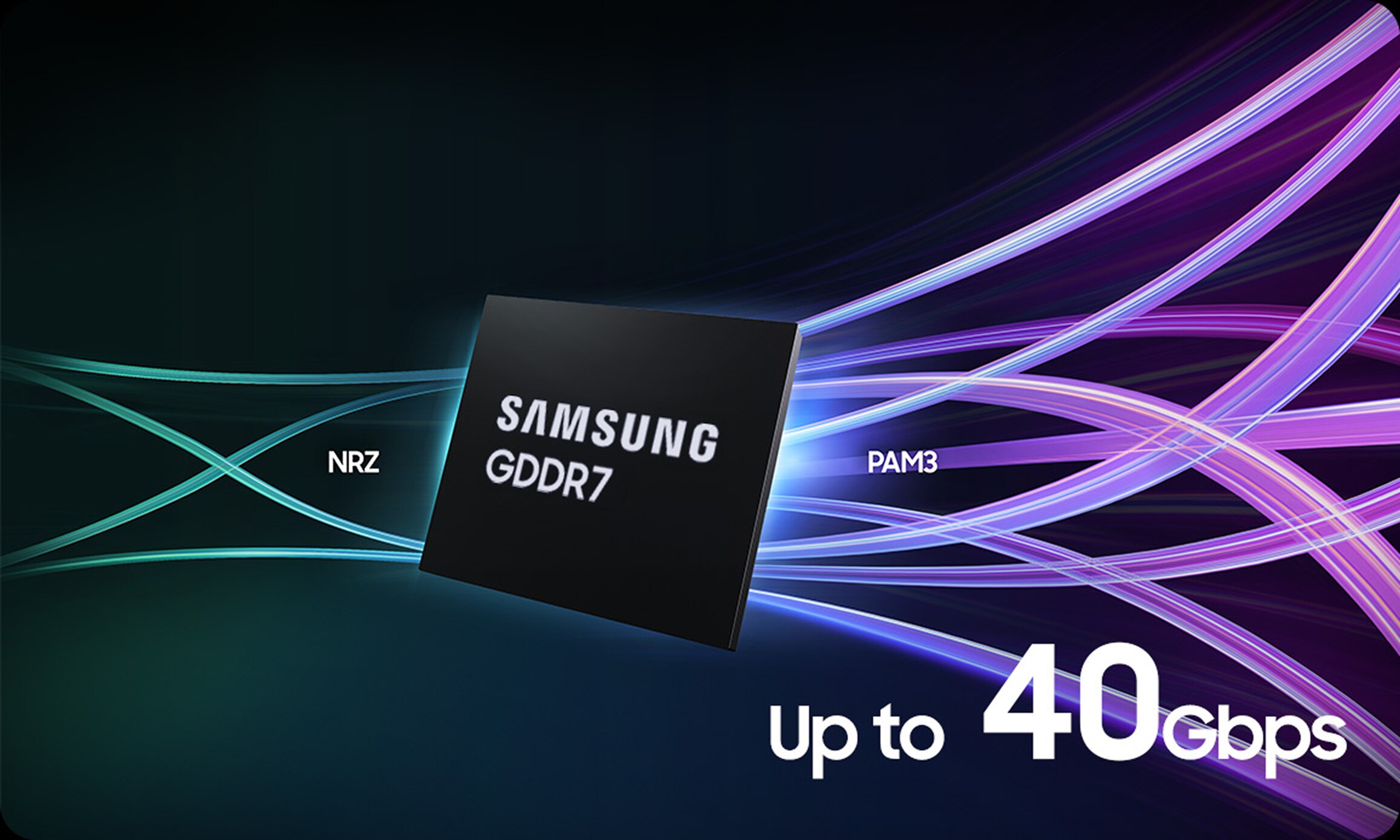
Samsung’s GDDR7 achieves up to 25% higher I/O speed per pin compared to the previous generation, delivering leading performance among standardized graphics memory products. This is enabled by the industry’s first application of PAM3 signaling2), which encodes data using three signal levels rather than two in conventional NRZ3), improving bit-level efficiency. This increase in per-pin data rate translates into higher overall bandwidth, enabling faster data processing for AI and graphics workloads.
2) Pulse Amplitude Modulation 3 (PAM3), a signaling method using three signal levels
3) Non Return to Zero (NRZ), a signaling method using two signal levels
Samsung’s GDDR7 achieves up to 25% higher I/O speed per pin compared to the previous generation, delivering leading performance among standardized graphics memory products. This is enabled by the industry’s first application of PAM3 signaling2), which encodes data using three signal levels rather than two in conventional NRZ3), improving bit-level efficiency. This increase in per-pin data rate translates into higher overall bandwidth, enabling faster data processing for AI and graphics workloads.
2) Pulse Amplitude Modulation 3 (PAM3), a signaling method using three signal levels
3) Non Return to Zero (NRZ), a signaling method using two signal levels
Samsung’s GDDR7 achieves up to 25% higher I/O speed per pin compared to the previous generation, delivering leading performance among standardized graphics memory products. This is enabled by the industry’s first application of PAM3 signaling2), which encodes data using three signal levels rather than two in conventional NRZ3), improving bit-level efficiency. This increase in per-pin data rate translates into higher overall bandwidth, enabling faster data processing for AI and graphics workloads.
2) Pulse Amplitude Modulation 3 (PAM3), a signaling method using three signal levels
3) Non Return to Zero (NRZ), a signaling method using two signal levels
GDDR7 improves power efficiency by up to 30%4), enabling lower power consumption while sustaining high performance.
In addition, optimized power management helps reduce standby power consumption, contributing to improved operational efficiency
and a lower total cost of ownership (TCO).
4) Comparison with the GDDR7 16Gb
GDDR7 improves power efficiency by up to 30%4), enabling lower power consumption while sustaining high performance. In addition, optimized power management helps reduce standby power consumption, contributing to improved operational efficiency and a lower total cost of ownership (TCO).
4) Comparison with the GDDR7 16Gb
GDDR7 improves power efficiency by up to 30%4), enabling lower power consumption while sustaining high performance. In addition, optimized power management helps reduce standby power consumption, contributing to improved operational efficiency and a lower total cost of ownership (TCO).
4) Comparison with the GDDR7 16Gb

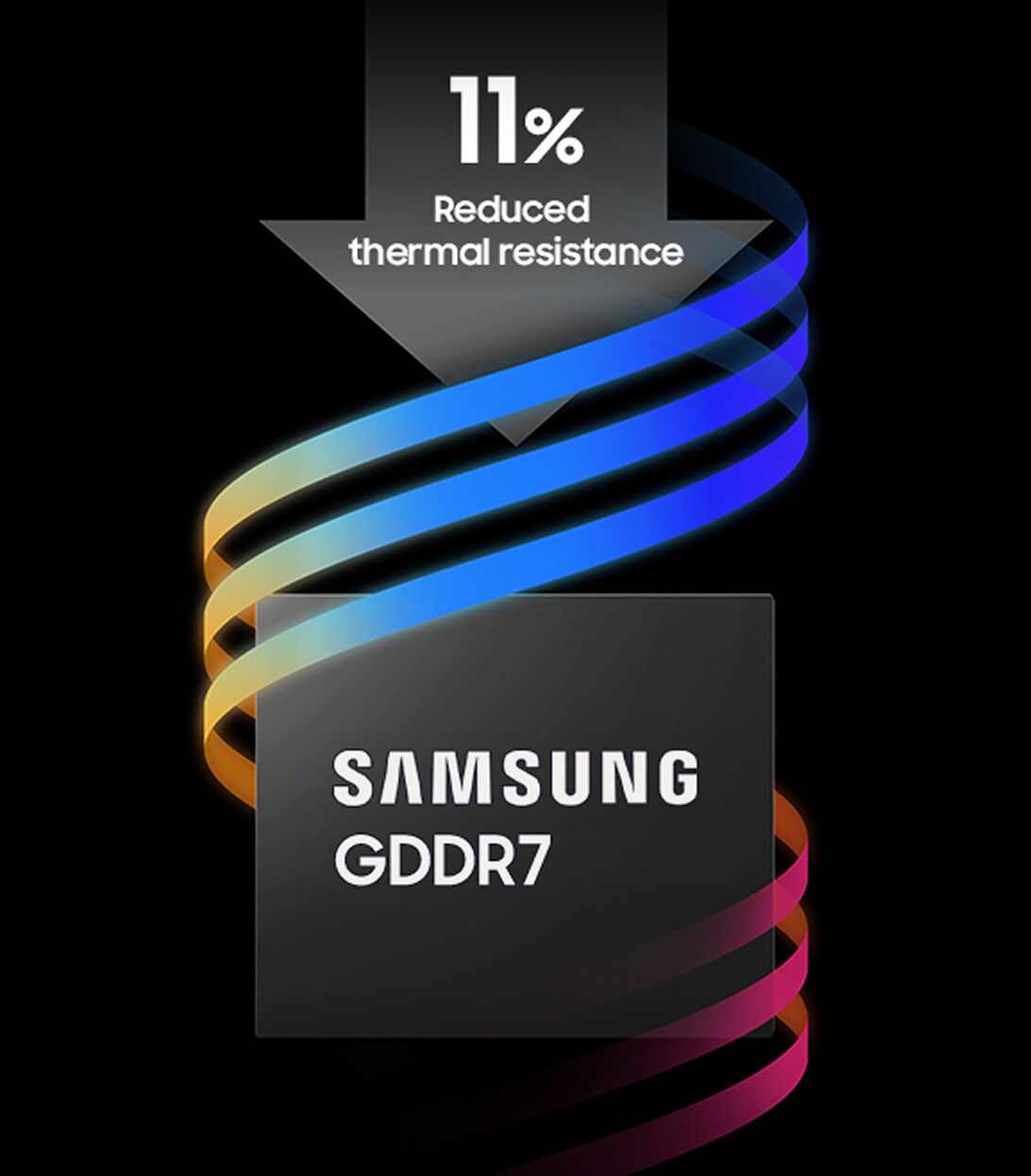
Enhanced reliability through improved thermal stability. GDDR7 achieves 11% reduction in thermal resistance5) through newly introduced package materials and an optimized circuit design.
By improving heat dissipation, it helps maintain stable operation under sustained workloads, reducing the risk of performance loss and other potential hardware issues.
5) Comparison with the GDDR7 16Gb
Enhanced reliability through improved thermal stability. GDDR7 achieves 11% reduction in thermal resistance5) through newly introduced package materials and an optimized circuit design.
By improving heat dissipation, it helps maintain stable operation under sustained workloads, reducing the risk of performance loss and other potential hardware issues.
5) Comparison with the GDDR7 16Gb
Enhanced reliability through improved thermal stability. GDDR7 achieves 11% reduction in thermal resistance5) through newly introduced package materials and an optimized circuit design.
By improving heat dissipation, it helps maintain stable operation under sustained workloads, reducing the risk of performance loss and other potential hardware issues.
5) Comparison with the GDDR7 16Gb
GDDR7 is a next-generation high-speed memory optimized for speed,
power efficiency, and cost-effectiveness in current graphics and AI computing environments.
- Speed: Suitable for data-intensive tasks like 4K–8K graphics, high-refresh-rate gaming, and AI inference.
- Power efficiency: Uses PAM3 signaling for higher transfer efficiency, reducing power consumption and heat.
- Cost efficiency: Provides high bandwidth at lower cost than HBM, making it an attractive alternative for performance-demanding
but budget-sensitive systems.
GDDR7 is a next-generation high-speed memory optimized for speed,
power efficiency, and cost-effectiveness in current graphics
and AI computing environments.
- Speed: Suitable for data-intensive tasks like 4K–8K graphics,
high-refresh-rate gaming, and AI inference.
- Power efficiency: Uses PAM3 signaling for higher transfer efficiency,
reducing power consumption and heat.
- Cost efficiency: Provides high bandwidth at lower cost than HBM,
making it an attractive alternative for performance-demanding
but budget-sensitive systems.
GDDR7 is a next-generation high-speed memory optimized for speed, power efficiency, and cost-effectiveness in current graphics and AI computing environments.
- Speed: Suitable for data-intensive tasks like 4K–8K graphics, high-refresh-rate gaming, and AI inference.
- Power efficiency: Uses PAM3 signaling for higher transfer efficiency, reducing power consumption and heat.
- Cost efficiency: Provides high bandwidth at lower cost than HBM, making it an attractive alternative for performance-demanding but budget-sensitive systems.
GDDR7 is a next-generation graphics DRAM designed for high bandwidth,
high efficiency, and low power—targeting graphics, AI, and high-performance systems.
It serves as a key enabler for future computing environments such as
high-resolution image processing, AI inference acceleration, and sensor fusion in autonomous driving.
GDDR7 is a next-generation graphics DRAM designed for high bandwidth,
high efficiency, and low power—targeting graphics, AI, and high-performance systems.
It serves as a key enabler for future computing environments such as
high-resolution image processing, AI inference acceleration,
and sensor fusion in autonomous driving.
GDDR7 is a next-generation graphics DRAM designed for high bandwidth, high efficiency, and low power—targeting graphics, AI, and high-performance systems.
It serves as a key enabler for future computing environments such as high-resolution image processing, AI inference acceleration, and sensor fusion in autonomous driving.
GDDR is designed for parallelism and bandwidth as a high-speed graphics memory,
whereas standard DDR is designed for general-purpose use and higher capacity as system memory.
Both belong to the DRAM family, but differ fundamentally in architecture, clocking,
bus structure, and I/O design to suit their respective purposes.
GDDR is designed for parallelism and bandwidth as a high-speed graphics memory,
whereas standard DDR is designed for general-purpose use
and higher capacity as system memory.
Both belong to the DRAM family, but differ fundamentally in architecture, clocking,
bus structure, and I/O design to suit their respective purposes.
GDDR is designed for parallelism and bandwidth as a high-speed graphics memory, whereas standard DDR is designed for general-purpose use and higher capacity as system memory.
Both belong to the DRAM family, but differ fundamentally in architecture, clocking, bus structure, and I/O design to suit their respective purposes.
The main differences between GDDR7 and GDDR6 are improvements in bandwidth, data transfer speed, and signaling technology.
GDDR7 is designed to deliver significantly higher performance, offering faster data rates and greater bandwidth than GDDR6,
even within similar interface widths.
One of the key advancements is the use of PAM3 (Pulse Amplitude Modulation 3-level) signaling,
which allows GDDR7 to transmit more data per clock cycle compared to the NRZ signaling used in GDDR6.
GDDR7 also provides better power efficiency, enabling higher performance while reducing overall power consumption.
The main differences between GDDR7 and GDDR6 are improvements in bandwidth,
data transfer speed, and signaling technology.
GDDR7 is designed to deliver significantly higher performance,
offering faster data rates and greater bandwidth than GDDR6,
even within similar interface widths.
One of the key advancements is the use of PAM3 (Pulse Amplitude Modulation 3-level)
signaling, which allows GDDR7 to transmit more data per clock cycle
compared to the NRZ signaling used in GDDR6.
GDDR7 also provides better power efficiency,
enabling higher performance while reducing overall power consumption.
The main differences between GDDR7 and GDDR6 are improvements in bandwidth, data transfer speed, and signaling technology.
GDDR7 is designed to deliver significantly higher performance, offering faster data rates and greater bandwidth than GDDR6, even within similar interface widths.
One of the key advancements is the use of PAM3 (Pulse Amplitude Modulation 3-level) signaling, which allows GDDR7 to transmit more data per clock cycle compared to the NRZ signaling used in GDDR6.
GDDR7 also provides better power efficiency, enabling higher performance while reducing overall power consumption.
GDDR7 is not a type of system memory that is installed on a standard PC motherboard.
Instead, it is a high-bandwidth graphics DRAM that is soldered directly onto GPUs, AI accelerators,
and high-performance computing modules. Because GDDR7 provides extremely high bandwidth and fast data transfer,
it is used in environments that require rapid memory processing, such as advanced graphics rendering, real-time visualization,
machine learning inference, and large-scale parallel computing.
In other words, GDDR7 is a memory technology used on GPUs and accelerator hardware, not on general-purpose motherboards.
GDDR7 is not a type of system memory that is installed on a standard PC motherboard.
Instead, it is a high-bandwidth graphics DRAM that is soldered directly onto GPUs, AI accelerators,
and high-performance computing modules. Because GDDR7 provides extremely high bandwidth
and fast data transfer, it is used in environments that require rapid memory processing,
such as advanced graphics rendering, real-time visualization, machine learning inference,
and large-scale parallel computing.
In other words, GDDR7 is a memory technology used on GPUs and accelerator hardware,
not on general-purpose motherboards.
GDDR7 is not a type of system memory that is installed on a standard PC motherboard.
Instead, it is a high-bandwidth graphics DRAM that is soldered directly onto GPUs, AI accelerators, and high-performance computing modules. Because GDDR7 provides extremely high
bandwidth and fast data transfer, it is used in environments that require rapid memory processing, such as advanced graphics rendering, real-time visualization,machine learning inference, and large-scale parallel computing.
In other words, GDDR7 is a memory technology used on GPUs and accelerator hardware, not on general-purpose motherboards.
https://semiconductor.samsung.com/support/contact-info/global-network/

 Global