
Samsung PM1763 is a PCIe® Gen6 enterprise SSD engineered to support emerging storage requirements in modern AI and high-performance computing environments. With high-throughput data processing, improved power efficiency, and enhanced security capabilities, PM1763 is well suited for deployment across hyperscale data center architectures. Samsung PM1763 is a PCIe® Gen6 enterprise SSD engineered to support emerging storage requirements in modern AI and high-performance computing environments. With high-throughput data processing, improved power efficiency, and enhanced security capabilities, PM1763 is well suited for deployment across hyperscale data center architectures. Samsung PM1763 is a PCIe® Gen6 enterprise SSD engineered to support emerging storage requirements in modern AI and high-performance computing environments. With high-throughput data processing, improved power efficiency, and enhanced security capabilities, PM1763 is well suited for deployment across hyperscale data center architectures.
PM1763 enables stable PAM4 signaling in PCIe Gen6 environments, achieving up to 2× higher performance1) compared to the previous generation. With sequential read speeds of up to 28,400 MB/s and write speeds of up to 21,000 MB/s, PM1763 is designed to help reduce data transfer constraints and support efficient data movement across AI-driven workloads.
1) Based on internal evaluations, performance may vary depending on system configuration and environment. (Details available upon request)
PM1763 enables stable PAM4 signaling in PCIe Gen6 environments, achieving up to 2× higher performance1) compared to the previous generation. With sequential read speeds of up to 28,400 MB/s and write speeds of up to 21,000 MB/s, PM1763 is designed to help reduce data transfer constraints and support efficient data movement across AI-driven workloads.
1) Based on internal evaluations, performance may vary depending on system configuration and environment. (Details available upon request)
PM1763 enables stable PAM4 signaling in PCIe Gen6 environments, achieving up to 2× higher performance1) compared to the previous generation. With sequential read speeds of up to 28,400 MB/s and write speeds of up to 21,000 MB/s, PM1763 is designed to help reduce data transfer constraints and support efficient data movement across AI-driven workloads.
1) Based on internal evaluations, performance may vary depending on system configuration and environment. (Details available upon request)

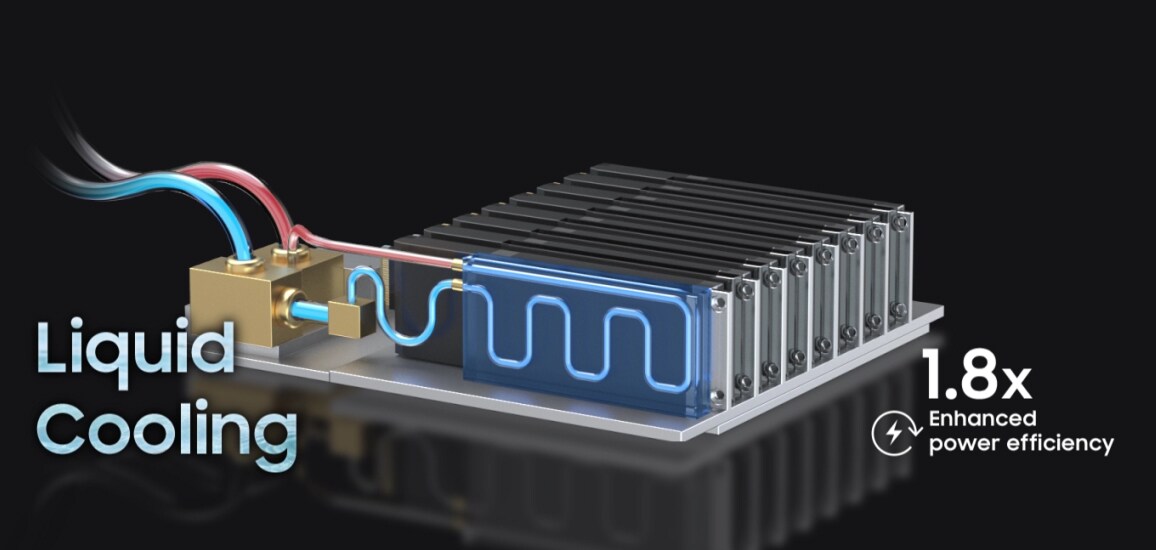
PM1763 incorporates controller architecture optimizations and design enhancements to improve power efficiency by up to 1.8×2) compared to the previous generation. Designed with thermal considerations, PM1763 aligns with emerging server architectures—including liquid-cooled systems—supporting flexible integration in performance-focused, high-density deployments.
2) Based on internal evaluations, performance may vary depending on system configuration and environment. (Details available upon request)
PM1763 incorporates controller architecture optimizations and design enhancements to improve power efficiency by up to 1.8×2) compared to the previous generation. Designed with thermal considerations, PM1763 aligns with emerging server architectures—including liquid-cooled systems—supporting flexible integration in performance-focused, high-density deployments.
2) Based on internal evaluations, performance may vary depending on system configuration and environment. (Details available upon request)
PM1763 incorporates controller architecture optimizations and design enhancements to improve power efficiency by up to 1.8×2) compared to the previous generation. Designed with thermal considerations, PM1763 aligns with emerging server architectures—including liquid-cooled systems—supporting flexible integration in performance-focused, high-density deployments.
2) Based on internal evaluations, performance may vary depending on system configuration and environment. (Details available upon request)
PM1763 supports security requirements for AI-driven and virtualized infrastructures. Support for PQC3), SPDM4) 1.4, and CNSA5) 2.0, along with TDISP6)-based link encryption, helps reinforce data protection and integrity across storage interfaces.
※ Acronyms are defined for reference.
3) PQC (Post-Quantum Cryptography): Cryptographic techniques designed to maintain security in the presence of quantum computing capabilities.
4) SPDM (Security Protocol and Data Model): A standard protocol for device authentication and secure communication between components.
5) CNSA (Commercial National Security Algorithm Suite): A set of cryptographic algorithms defined to support security requirements in the post-quantum era.
6) TDISP (TEE Device Interface Security Protocol): A security protocol that enables protected data exchange between devices and hosts in virtualized environments.
7) SED (Self-Encrypting Drive): A storage device that automatically encrypts data using built-in hardware to protect information at rest.
8) IDE (Integrity and Data Encryption): A security feature that protects data by providing encryption and integrity verification during transmission.
PM1763 supports security requirements for AI-driven and virtualized infrastructures. Support for PQC3), SPDM4) 1.4, and CNSA5) 2.0, along with TDISP6)-based link encryption, helps reinforce data protection and integrity across storage interfaces.
※ Acronyms are defined for reference.
3) PQC (Post-Quantum Cryptography): Cryptographic techniques designed to maintain security in the presence of quantum computing capabilities.
4) SPDM (Security Protocol and Data Model): A standard protocol for device authentication and secure communication between components.
5) CNSA (Commercial National Security Algorithm Suite): A set of cryptographic algorithms defined to support security requirements in the post-quantum era.
6) TDISP (TEE Device Interface Security Protocol): A security protocol that enables protected data exchange between devices and hosts in virtualized environments.
7) SED (Self-Encrypting Drive): A storage device that automatically encrypts data using built-in hardware to protect information at rest.
8) IDE (Integrity and Data Encryption): A security feature that protects data by providing encryption and integrity verification during transmission.
PM1763 supports security requirements for AI-driven and virtualized infrastructures. Support for PQC3), SPDM4) 1.4, and CNSA5) 2.0, along with TDISP6)-based link encryption, helps reinforce data protection and integrity across storage interfaces.
※ Acronyms are defined for reference.
3) PQC (Post-Quantum Cryptography): Cryptographic techniques designed to maintain security in the presence of quantum computing capabilities.
4) SPDM (Security Protocol and Data Model): A standard protocol for device authentication and secure communication between components.
5) CNSA (Commercial National Security Algorithm Suite): A set of cryptographic algorithms defined to support security requirements in the post-quantum era.
6) TDISP (TEE Device Interface Security Protocol): A security protocol that enables protected data exchange between devices and hosts in virtualized environments.
7) SED (Self-Encrypting Drive): A storage device that automatically encrypts data using built-in hardware to protect information at rest.
8) IDE (Integrity and Data Encryption): A security feature that protects data by providing encryption and integrity verification during transmission.

PM1763 supports E1.S, E3.S and U.29) form factors with capacities ranging from 4 TB to 64 TB, enabling flexible configurations based on system requirements. Built on PCIe Gen6-based NVMe® 2.1 and OCP® 2.6 standards, PM1763 aligns with evolving platform requirements while maintaining compatibility with existing infrastructures. Expanded telemetry and enhanced error recovery further contribute to reliable operation in large-scale data center environments.
9) U.2 form factor supports PCIe Gen5 interface only.
PM1763 supports E1.S, E3.S and U.29) form factors with capacities ranging from 4 TB to 64 TB, enabling flexible configurations based on system requirements. Built on PCIe Gen6-based NVMe® 2.1 and OCP® 2.6 standards, PM1763 aligns with evolving platform requirements while maintaining compatibility with existing infrastructures. Expanded telemetry and enhanced error recovery further contribute to reliable operation in large-scale data center environments.
9) U.2 form factor supports PCIe Gen5 interface only.
PM1763 supports E1.S, E3.S and U.29) form factors with capacities ranging from 4 TB to 64 TB, enabling flexible configurations based on system requirements. Built on PCIe Gen6-based NVMe® 2.1 and OCP® 2.6 standards, PM1763 aligns with evolving platform requirements while maintaining compatibility with existing infrastructures. Expanded telemetry and enhanced error recovery further contribute to reliable operation in large-scale data center environments.
9) U.2 form factor supports PCIe Gen5 interface only.


Evolution of semiconductor solutions for servers
https://semiconductor.samsung.com/support/contact-info/global-network/

 Global