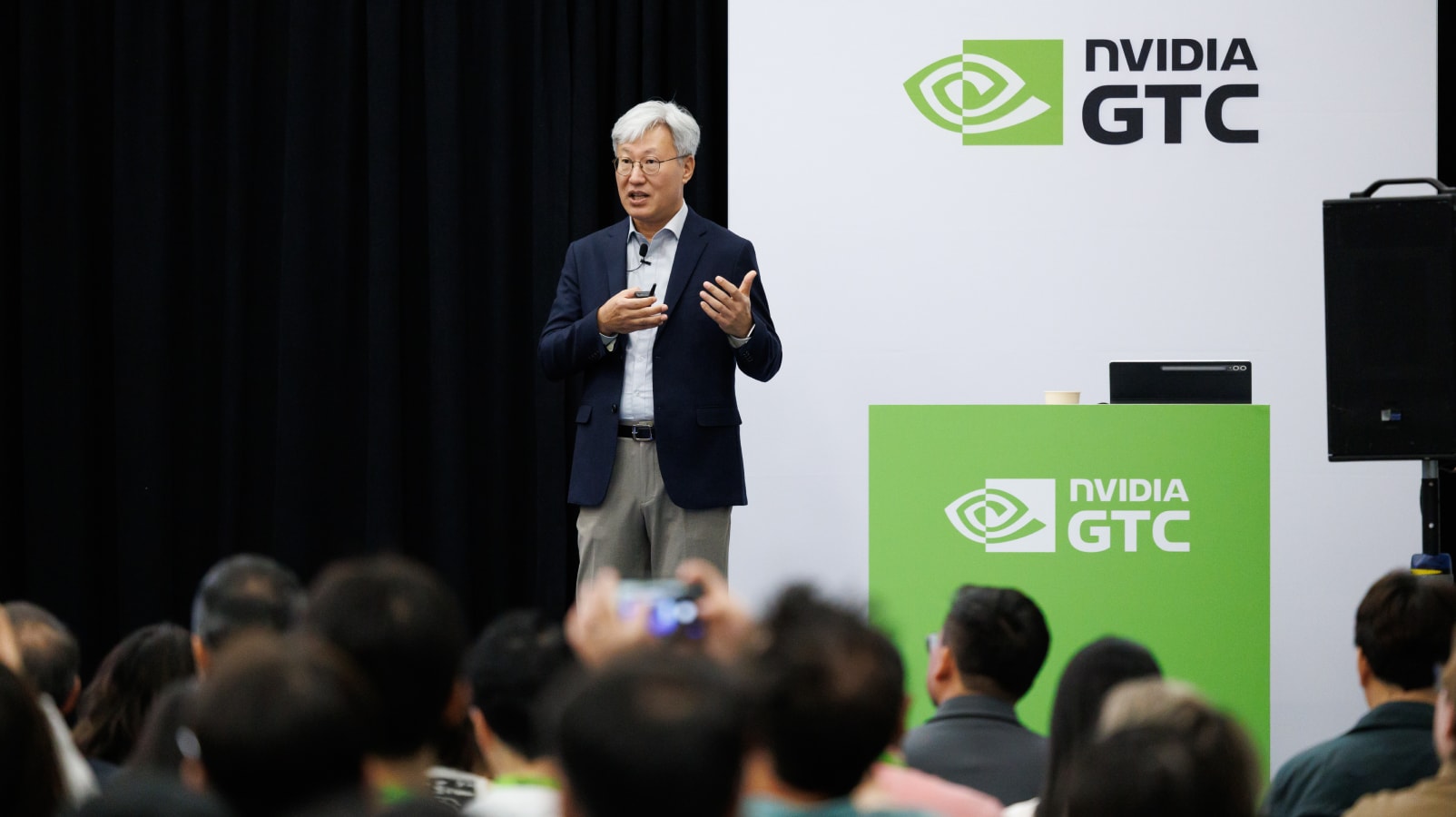
On March 17 (local time), the second day of NVIDIA GTC, Yong Ho Song, Executive Vice President and Head of the AI Center at Samsung Electronics’ DS division, delivered a session titled “Transforming Semiconductor Manufacturing with Agentic AI from Design and Engineering to Production.” In his presentation, Song addressed the rapidly increasing complexity of semiconductor technologies and introduced Samsung’s Agentic AI–driven engineering strategy. Rather than optimizing each stage in isolation, this approach focuses on holistic optimization across the entire semiconductor value chain—from design and engineering to manufacturing. This strategy outlines a clear direction for next-generation semiconductor engineering, enabling Samsung to enhance both product quality and operational efficiency amid growing AI-driven complexity.
Design: advancing automation and optimization with Agentic AI
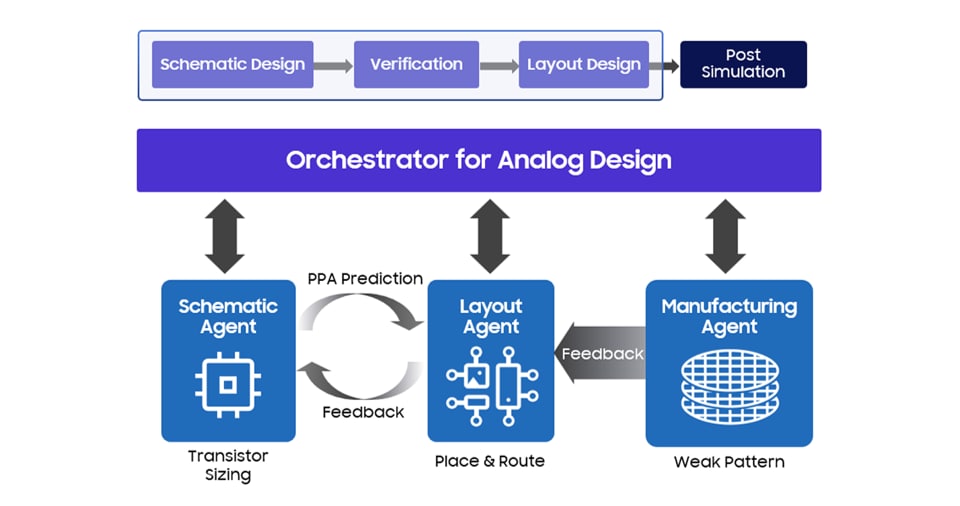
Samsung is applying Agentic AI to enhance both efficiency and quality across its design workflows, with a particular focus on analog and logic design. Analog design plays a critical role in determining the performance of AI-optimized products such as HBM. Due to the need to balance numerous variables and constraints, it has traditionally required extensive iterative refinement. To address this, Samsung has incorporated advanced AI techniques—including reinforcement learning and genetic algorithms—to automate transistor sizing and accelerate circuit design. Potential Design Rule Check (DRC) violations are also predicted in advance and incorporated into the layout design. As a result, design turnaround time has been reduced by approximately 50%, enabling speeds of up to 13 Gbps per pin in HBM4.
Looking ahead, Samsung is moving beyond conventional workflows in which schematic and layout are optimized separately, toward a co-optimization framework that enables continuous feedback across stages. At the core of this approach is a multi-agent workflow, where specialized AI agents collaborate across the design process. A schematic design agent predicts performance, power, and area (PPA) prior to layout generation, while a layout agent autonomously refines designs in response to schematic updates. Manufacturing insights—such as wafer-level pattern data—are also fed back into earlier stages to enhance overall design outcomes. This coordinated approach reduces iteration cycles, further improving both design efficiency and product competitiveness.
The session also featured a guest speaker from Synopsys, highlighting the evolution of their collaboration from Generative AI to Agentic AI, powered by NVIDIA GPU-accelerated computing. It demonstrated cross-functional collaboration across Samsung’s Memory, Computational Science & Engineering (CSE), and Process Development teams, showcasing tangible outcomes of AI-driven innovation in semiconductor design.
Manufacturing: advancing quality with Agentic AI and Digital Twin
No matter how well a chip is optimized in design—even with Agentic AI—scaling it into high-volume production remains a significant challenge. In advanced memory such as HBM4E, even minor process variations can have a substantial impact on quality and yield.
To address this, Samsung is evolving its manufacturing quality management beyond conventional Manufacturing Execution System (MES) by integrating Agentic AI. By analyzing large-scale manufacturing data in real time, root causes of anomalies can be identified and addressed quickly across equipment operations, process control, and yield management. In equipment operations, AI detects alarms and supports rapid issue resolution. In process control, it enables instant defect detection and corrective actions. In yield management, AI analyzes deviations and recommends optimal diagnostic actions.
Samsung is moving beyond domain-specific monitoring toward an AI-driven orchestration framework that manages the entire manufacturing process as an integrated system. To further enhance visibility and control, Samsung has recreated a full-scale semiconductor fab as a Digital Twin built on NVIDIA Omniverse. Connected with MES, this environment enables real-time monitoring, predictive risk assessment, and proactive intervention—while allowing simulation and validation of production scenarios in advance. During the session, Samsung unveiled its Pyeongtaek fab Digital Twin, demonstrating full-scale virtual manufacturing capabilities and reinforcing its collaboration with NVIDIA.
End-to-end AI innovation partnership with NVIDIA
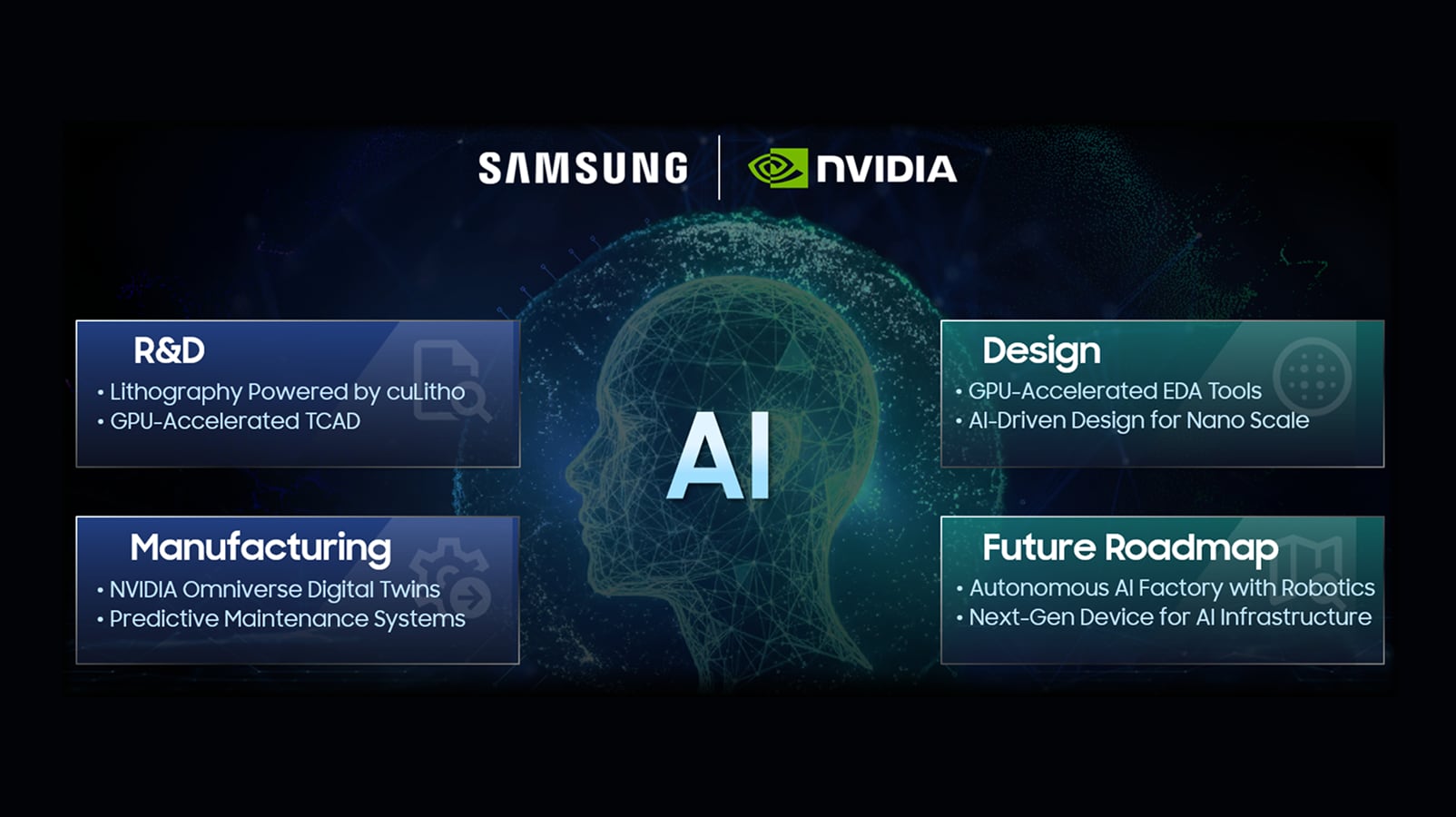
These advancements—from design to manufacturing—have been made possible through close collaboration with NVIDIA. Samsung leverages NVIDIA’s GPU-accelerated computing as a common foundation across R&D and design, driving innovations from cuLitho-powered lithography to TCAD and EDA optimization in collaboration with Synopsys. In manufacturing, Samsung integrates NVIDIA Omniverse-based Digital Twins and predictive maintenance systems to enable real-time fab operations and proactive quality management. Looking ahead, Samsung aims to advance toward an autonomous AI factory—where robotics and AI are seamlessly integrated. Together, these efforts extend beyond individual innovations to deliver system-level optimization across the entire semiconductor value chain.
Continuous AI innovation with global partners
This collaboration has delivered tangible outcomes, including Samsung’s integrated memory and storage solutions for NVIDIA Vera Rubin. Through key products such as HBM4, SOCAMM2, and PM1763, Samsung presented a comprehensive portfolio for high-performance AI infrastructure. HBM4 and HBM4E support AI training, while SOCAMM2 and PM1763 enable efficient inference and data processing. Beyond individual products, this represents system-level integration across the full memory and storage hierarchy required by next-generation AI platforms.
The session drew strong on-site interest, attracting a full audience and significant attention from media and industry stakeholders. Samsung’s collaboration with NVIDIA was recognized for extending beyond memory supply to broader semiconductor engineering innovation, incorporating Agentic AI and Digital Twin technologies.
The presentation further highlighted Samsung’s ability to translate its end-to-end strategy into real technologies and products, offering a clear direction for next-generation semiconductor development. Looking ahead, Samsung will continue to advance core technologies for next-generation AI infrastructure in close collaboration with global partners—turning today’s challenges into tomorrow’s breakthroughs.

 Global