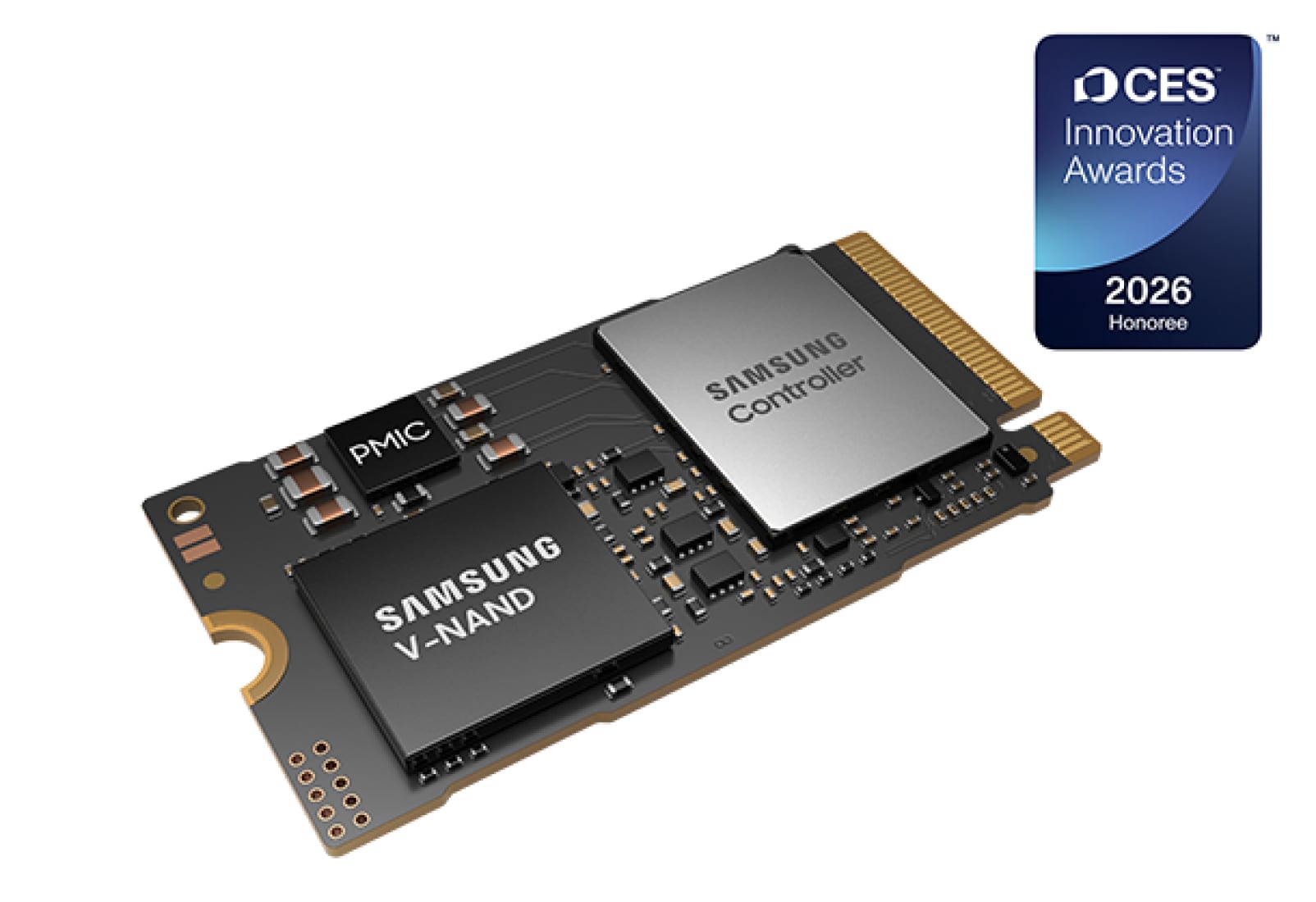
This year, Samsung Semiconductor earned seven CES Innovation Awards®, demonstrating how semiconductor technology continues to drive innovation across industries and enhance everyday life far beyond the functions of individual components. Among the honorees, the PM9E1 M.2 22x42 SSD—winner in the Computer Hardware & Components category—combines unprecedented capacity and breakthrough performance in an ultra-compact form factor, reinforcing Samsung’s leadership in storage solutions optimized for the accelerating demands of AI computing.
We spoke with the key contributors behind this innovation: Project Leader—ChangWoo Sun and Alex Choi from the Memory Product Planning Team, and Task Leader Sunki Yun and Project TL—Kijoong Kim from the Solution Product & Development Team.
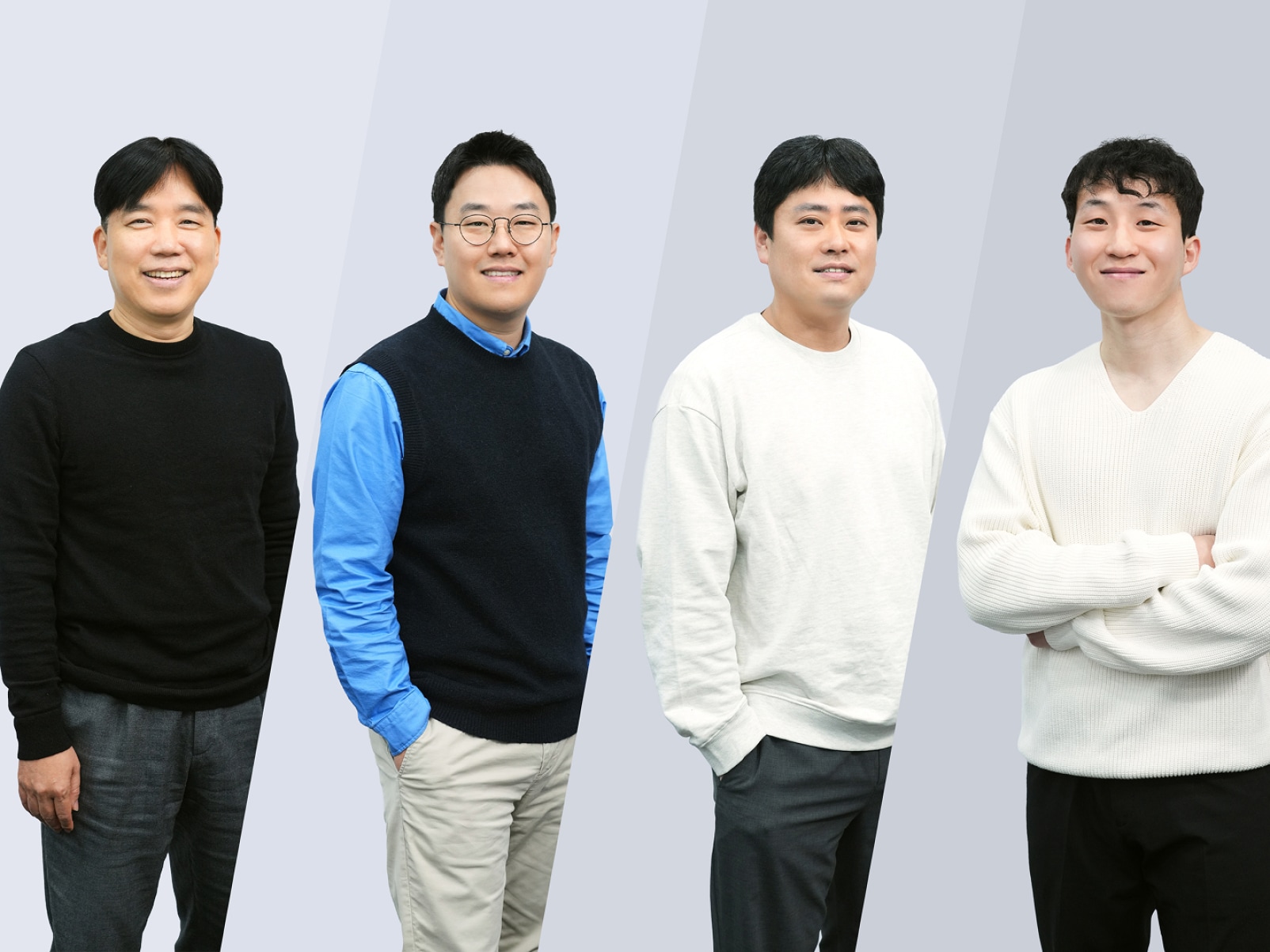
Q. To begin, could you introduce the PM9E1 M.2 22×42 SSD and the key features behind its recognition in the CES Innovation Awards 2026?
ChangWoo Sun: Samsung’s PM9E1 M.2 22x42 is the world’s first AI-optimized PCIe Gen5 NVMe SSD in an ultra-compact form factor—just 22 mm by 42 mm. We designed it for next-generation applications such as premium gaming, on-device AI, and high-end computing where both performance and spatial efficiency are critical.
Despite its small size, the PM9E1 delivers industry-leading sequential read and write speeds of up to 14.5 GB/s and 12.6 GB/s, respectively, along with capacities up to 4TB, which are unprecedented in such a compact drive, enabling users to build powerful, space-efficient systems without sacrificing performance.
Q. Among many competing SSDs, what specific innovations and technical breakthroughs helped the PM9E1 M.2 22x42 earn that recognition?
Alex Choi: The PM9E1 is the first SSD to adopt a double-sided design within the compact M.2 22x42 mm form factor. By strategically placing V8 NAND and DRAM on both sides of the PCB, we achieved a remarkable capacity of up to 4TB—something that was once considered extremely difficult in this size class. This breakthrough highlights Samsung’s advanced design and engineering capabilities and sets a new standard for compact, high-capacity storage.
Beyond capacity, the PM9E1 delivers exceptional performance with about 50% improvement in power efficiency, maintaining high speeds without compromise. Optimized for space-constrained AI PCs and high-performance laptops, it exemplifies how Samsung combines technical excellence with real-world practicality—one of the key reasons it received such high praise.

Q. As innovative as it is, you likely faced many challenges during development. Are there any memorable moments?
Sunki Yun: For high-capacity SSDs targeting client PC performance, components such as DRAM and NAND packages are essential. However, with the M.2 22x42 mm form factor, space is extremely limited—traditionally, only M.2 22x80 mm products with single-side, could accommodate all the necessary components.
Despite these constraints, our team was determined to deliver a high-capacity PCIe Gen5 SSD for AI PCs in this ultra-compact size, giving customers greater design freedom for their devices. To make that possible, we decided to apply a smaller NAND package–originally planned for the V9 generation– to V8 as well. Thanks to close collaboration with the Package Development Team, we were able to accelerate development and move the project forward quickly. Because of the strict space limitations, we had to place all the components including NAND, DRAM, and the controller on both sides of a very small PCB. This brought additional challenges in PCB layout, BOM optimization, thermal management, and mechanical reliability.
A memorable moment that stands out to me was during the Lunar New Year period, when our team stayed deeply engaged and focused on overcoming several key challenges, even amid a busy holiday season. That collaboration and determination helped us maintain momentum on an aggressive development timeline and ultimately deliver the best possible product.
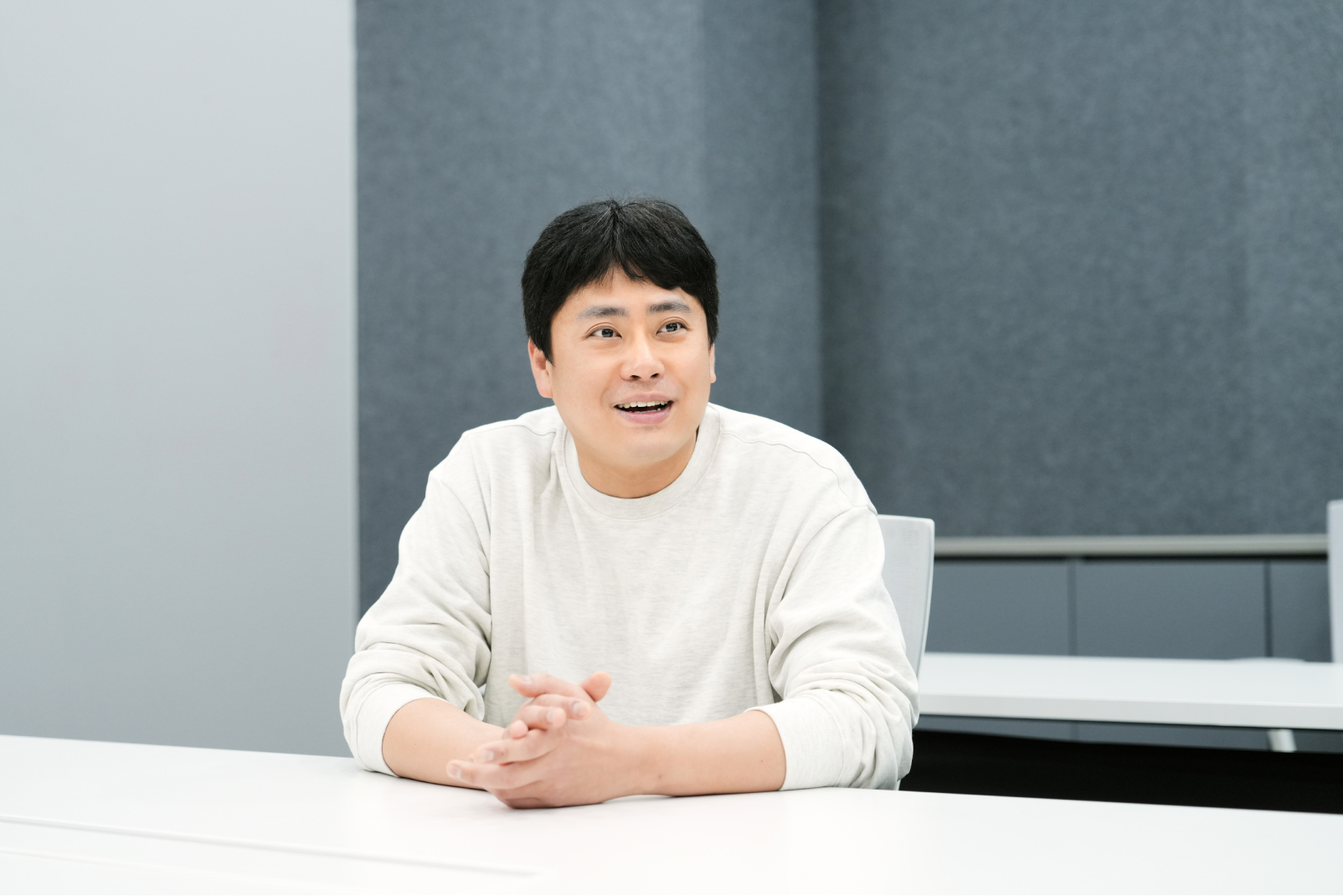
Q. To deal with multiple challenges, it seems that close cooperation among several departments took place. How did close collaboration across teams help you overcome challenges during development?
Kijoong Kim: The PM9E1 project was truly a unified effort. With an exceptionally shortened development period by about two and a half months, the process was demanding, but it left a strong impression on everyone involved. The product became something the entire team feels deeply connected to, driven by a shared determination to strengthen Samsung’s leadership in SSD technology for AI PCs.
During development, I participated as the Project TL (PTL). The team faced numerous technical challenges, but in order to achieve the original goals, various related departments such as package development, planning, quality, and production collaborated closely as if they were a single organization. Thanks to the rapid decision making of the team leaders and real-time collaboration across functions, we quickly shared our opinions to solve problems, allowing the entire project to function organically. In particular, the Solution Product & Development Team was able to immerse itself more deeply in the work thanks to the unwavering support of the head. I believe that this proactive leadership combined with cross organizational collaboration enabled us to implement the world’s first ultra-small, high capacity SSD architecture and complete a design optimized for AI workloads within a short period.
These delivered clear, tangible value to customers: faster loading of large-scale AI models, stable data processing, and a smoother overall user experience. The PM9E1’s ultra-compact, high-capacity design also gives PC platform designers much greater flexibility in system design.
Ultimately, I believe this project’s success stems not only from our technical capabilities but also from the power of cross-organizational communication, collaboration, and decisive execution.

Q. Since the design is highly integrated, the thermal management and durability enhancements must have been demanding as well. With such a highly integrated design, managing thermals and ensuring long-term durability must have been critical considerations. How did you approach these aspects?
Kijoong Kim: In the PM9E1, many components—such as NAND, DRAM, and PMIC—are packed into a very compact form factor, so thermal design was one of the most critical considerations from the start.
Today, as companies and individuals handle increasingly large volumes of data, memory workloads—and the heat they generate—have grown significantly. To ensure stability under these demanding conditions, we first created a mock sample and generated a detailed heat distribution map. Using this data, we designed an optimized hardware architecture that carefully accounted for both heat-sensitive BOM components and the power rails of each component.
Thermal management isn’t just about performance; it’s closely tied to mechanical reliability. For example, when multiple types of packages are mounted on a double-sided PCB, heat generation can cause expansion and contraction of PCB, affecting long-term temperature cycle (TC) reliability. To address this, we used PCB materials with a low coefficient of thermal expansion (CTE) and adopted side-fill technology to reduce deformation and reinforce TC reliability.
Given our tight development timeline, we also worked proactively with customers to help them understand the product’s characteristics. Early on, we provided thermal simulation models and 3D visualizations to align expectations and address potential thermal risks in advance.
Thanks to these efforts, the PM9E1 successfully achieves high throughput without performance degradation, even during extended AI workloads—allowing users to operate systems reliably and efficiently over the long term.
Q. The PM9E1 is described as an AI-optimized SSD. What key characteristics are required for SSDs in AI applications, and how does the PM9E1 address these needs?
Alex Choi: When running large language models (LLMs), one of the most representative AI workloads, systems must handle extremely intensive data loading and training operations. During training in particular, checkpoint operations—which frequently save the model’s state—require very high sequential write performance. The PM9E1, designed for performance-driven AI workloads, provides up to 12.6GB/s of sequential write speeds, helping these tasks run smoothly without bottlenecks. It also provides sequential read speeds of up to 14.5GB/s, which are crucial for quickly loading trained models and enabling fast, seamless inference and retraining. Together, these capabilities make the PM9E1 an ideal SSD for demanding AI applications.
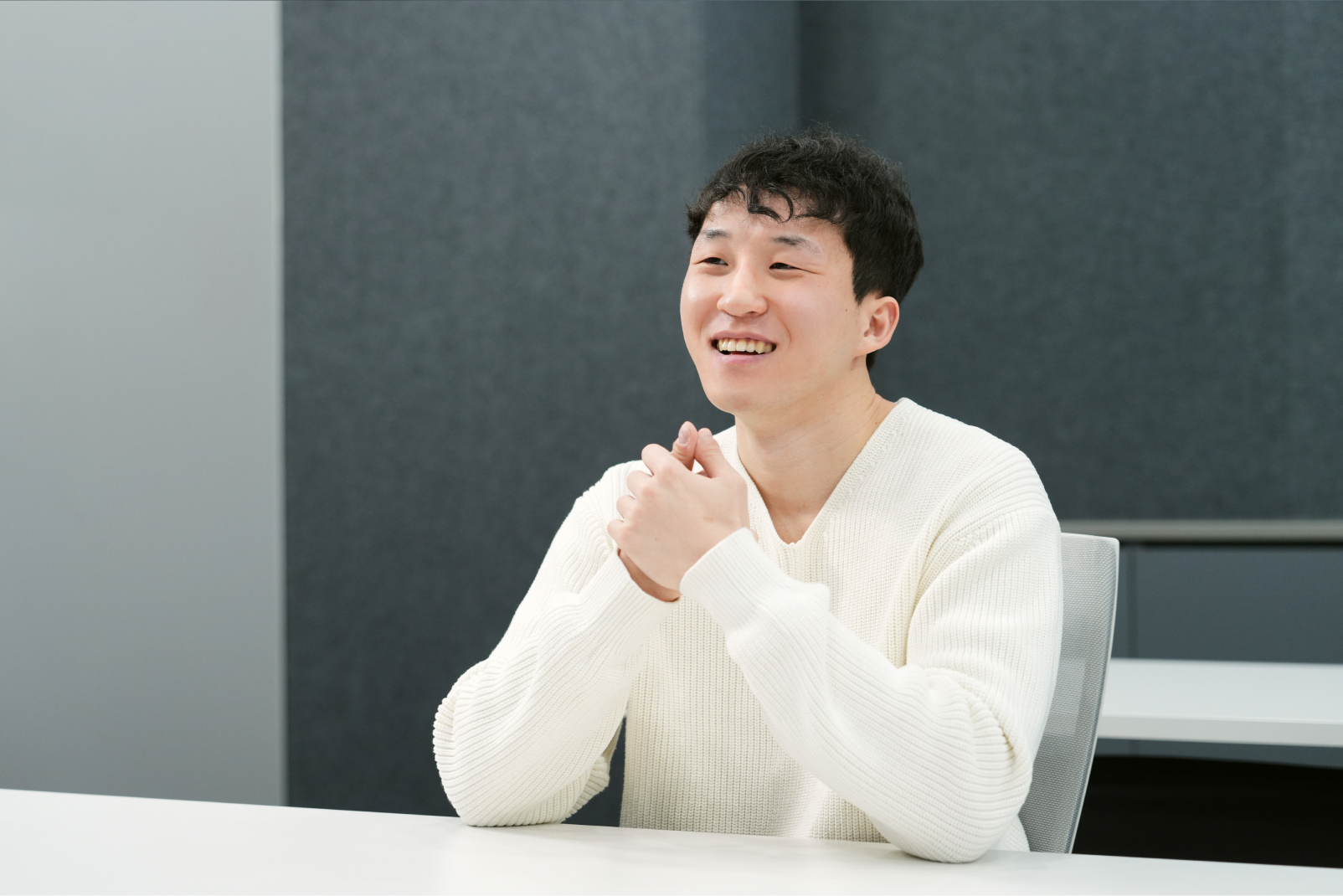
Q. What roles do you think the PM9E1 will play in the future SSD market?
ChangWoo Sun: The PM9E1 is a storage solution that achieves both an ultra-small form factor and high capacity through advanced dual-sided design technology. In particular, it will serve as a core high-performance, low-power storage option across a wide range of applications—from mobile devices to ultra-slim notebooks and edge servers. Beyond its compact design, the PM9E1 also paves the way for next-generation data infrastructure by expanding Samsung’s high-efficiency, high-density storage ecosystem.
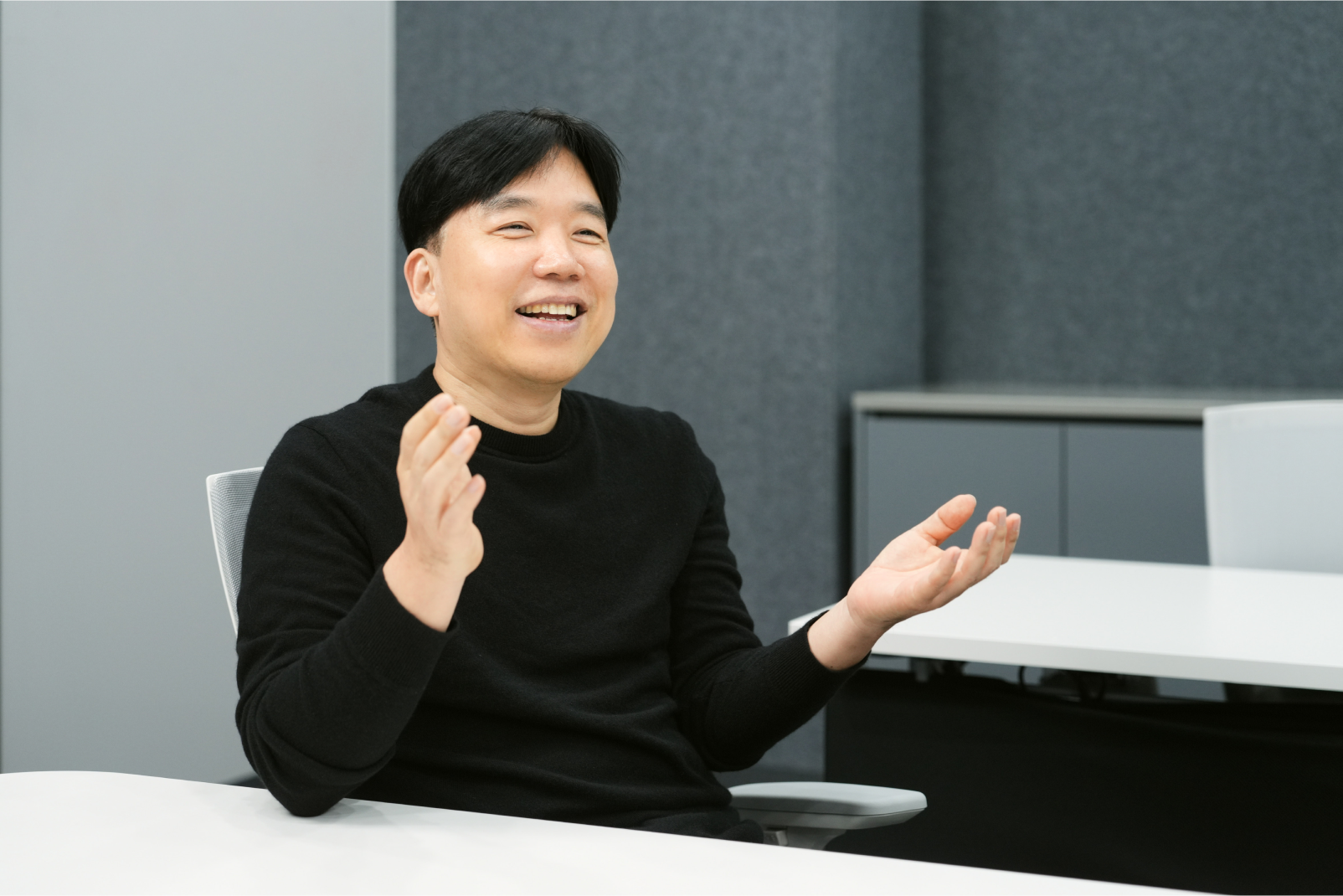
Kijoong Kim: The PM9E1 is an optimized SSD for AI workloads, delivering outstanding performance in large-scale AI model loading, on-device inference, and high-resolution content processing. It intelligently handles massive data volumes and maximizes computing efficiency, setting a new performance benchmark for the AI era. We expect it to play a key role in driving storage innovation for future AI PCs and other high-performance platforms.
Alex Choi: The PM9E1 goes beyond the typical 1–2TB capacity range of today’s client SSDs, positioning itself as a compact yet high-capacity solution suited for high-performance computing environments, including AI supercomputing. It meets rapidly evolving market demands while showcasing Samsung’s technological leadership and competitiveness. In doing so, it strengthens our position in the client storage market and helps us capture future demand.
The PM9E1 is more than just a PC SSD—it redefines what’s possible in an era where AI and high-performance computing are becoming part of everyday life. Honored with a CES Innovation Award, Samsung’s PM9E1 will be showcased at the Las Vegas Convention Center during CES from January 6 to 9, 2026.
* All images shown are provided for illustrative purposes only and may not be an exact representation of the product. All images are digitally edited, modified, or enhanced.
* All product specifications reflect internal test results and are subject to variations by user's system configurations. Actual performance may vary depending on use conditions and environment.

 Global