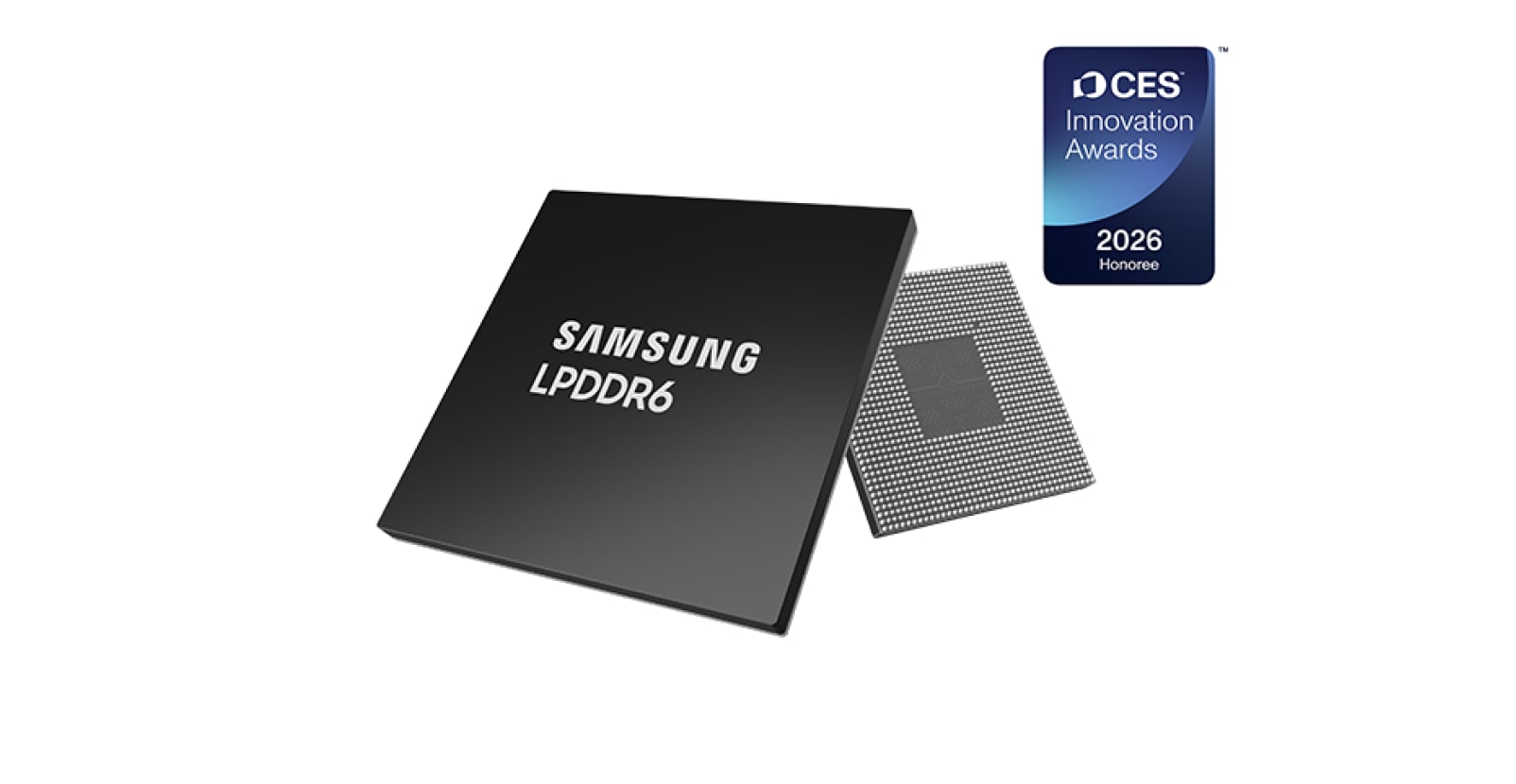
This year, Samsung Semiconductor earned seven CES Innovation Awards®, demonstrating how semiconductor technology continues to drive innovation across industries and enhance everyday life far beyond the role of individual components. Among the honorees, LPDDR6 – the world’s first next-generation low-power DRAM and recognized in the Mobile Devices, Accessories & Apps category – highlights Samsung’s leadership in delivering unprecedented performance and best-in-class power efficiency tailored for mobile and AI-driven platforms.
We spoke with the team behind this innovation: Project Leaders Jay Oh and Seunghyun Moon from the Memory Product Planning Team; Jinyong Choi, Project Leader from the Advanced DRAM Technology Team; and Woo-seop Kim from the Technology Quality & Reliability Team.


Q. Please give a brief introduction to the LPDDR6 product that won the CES 2026 Innovation Award.
Jay Oh: As AI, edge computing, and mobile platforms advance, the need for faster, more efficient, and secure low-power memory continues to grow. Samsung’s LPDDR6—the first of its kind worldwide—is a next-generation solution engineered to meet these evolving demands.
Seunghyun Moon: LPDDR6 supports blazing-fast data rates of up to 10.7 Gbps and features an expanded I/O count to maximize bandwidth, making it ideal for data-intensive mobile applications, edge computing, and AI workloads. With support for capacities up to 16 GB, it delivers an optimal balance of performance, energy efficiency, and reliability—making it an essential memory solution for next-generation, high-performance on-device AI.
Q. You mentioned LPDDR6 is described as the world’s first next-generation low-power memory solution. What technical innovations enabled this breakthrough?
Jinyong Choi: LPDDR6 goes far beyond simply reducing power consumption through a finer process node. It has been fundamentally redesigned—from its circuit architecture to its power-management stages—to address the demands of the AI era. By separating the conventional DRAM power supply based on voltage requirements, we adopted several new features, including enhanced Dynamic Voltage and Frequency Scaling (DVFS)¹⁾ and Dynamic Efficiency Mode²⁾, which dynamically adjust power usage according to system requirements. This enables LPDDR6 to balance power and performance in real time, optimizing energy consumption and memory performance according to specific AI workloads such as real-time inferencing and machine-learning operations.
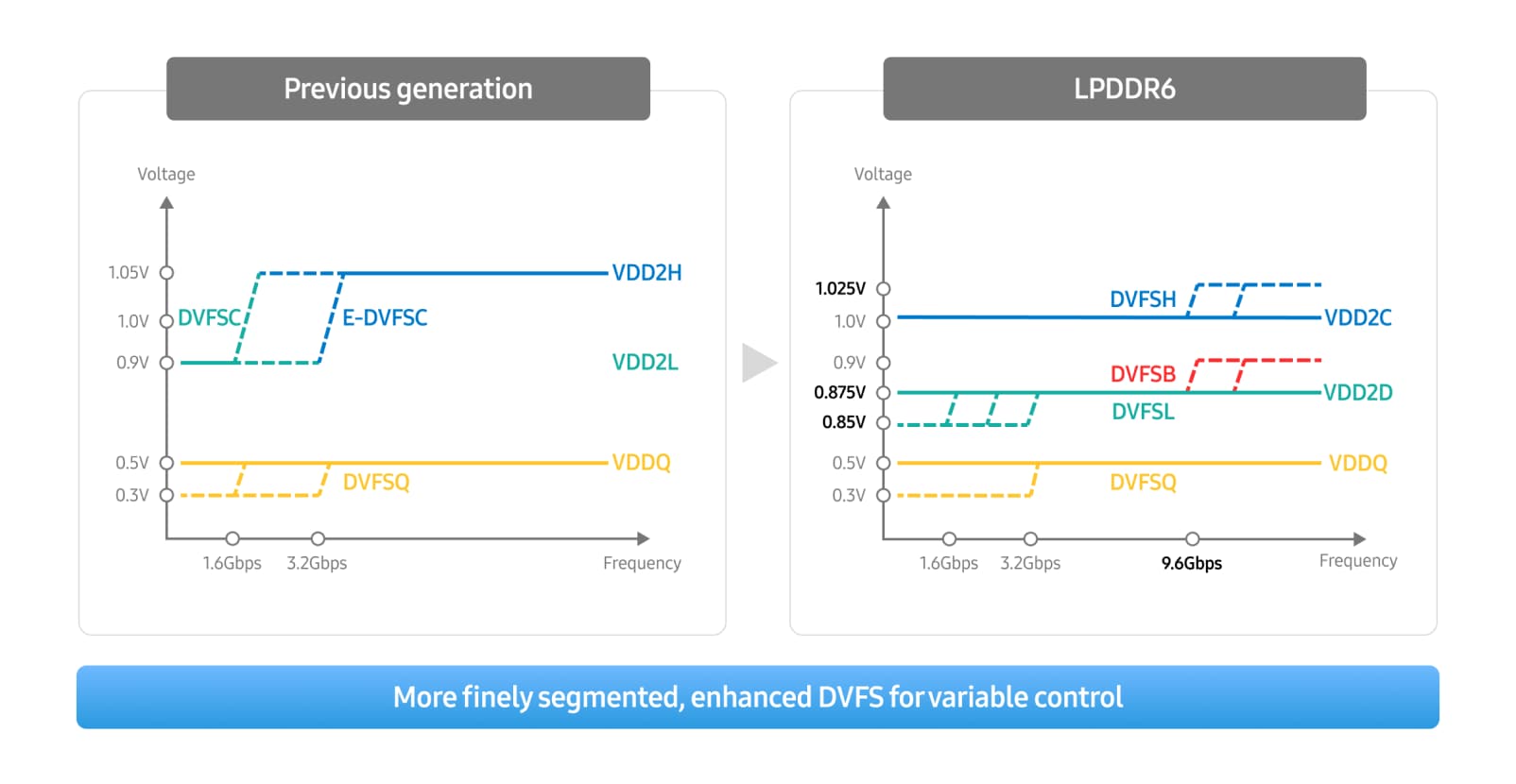
Samsung’s proprietary Smart PMIC adds another layer of intelligence by managing both internal and external power delivery. Combined with a new circuit design that expands the low-power operating range, LPDDR6 can finely tune power consumption based on AI computational load. Together, these innovations deliver approximately 21% greater energy efficiency over the previous generation while maintaining stable, high-speed performance.
Q. It sounds like a demanding project. What were your main goals, and what challenges did you face during development?
Jay Oh: Today, AI is used across PCs, laptops, and smartphones by both enterprises and consumers. As data volumes expand, we designed LPDDR6 to process large-bandwidth data quickly and reliably while minimizing power consumption. This required ensuring stable performance for AI inferencing, real-time computation, and other data-heavy workloads. Early validation and feedback from major SoC vendors helped us optimize the product, enabling us to be the first to bring it to consumers. We also worked closely with partners through proactive technical exchanges to ensure LPDDR6’s new features would deliver consistent performance across diverse system environments.


Jinyong Choi: The Memory Product Planning Team initially presented ambitious performance targets and aggressive timelines—which, to be honest, surprised me as a development engineer. Higher speeds are typically associated with increased power consumption, so maintaining efficiency at such high data rates, which were significantly advanced from the previous generation, required extensive cross-team collaboration—from component development and process optimization to evaluation and quality assurance. That teamwork significantly reduced trial-and-error and enabled us to achieve our challenging project goals.


Woo-seop Kim: Because Samsung’s LPDDR6 is a world-first product, we couldn’t rely on existing board-mount environments with SoC partners. To address this, we developed new single-component evaluation methodologies that allowed us to thoroughly validate LPDDR6’s architectural and security enhancements even before full system integration.
Q. Samsung’s LPDDR products have won CES Innovation Awards two years in a row—LPDDR5X and now LPDDR6. How do you see the role of low-power solutions evolving?
Jay Oh: Following last year’s LPDDR5X 10.7 Gbps product, LPDDR6 marks another major milestone and further establishes Samsung’s LPDDR as a driver of innovation. The demand for low-power technology—once concentrated in mobile devices—has now expanded across industries. LPDDR6’s enhanced compatibility allows it to be used in AI edge systems, AI PCs, data centers, and autonomous platforms. This shows that LPDDR is no longer limited to mobile—it is becoming an essential next-generation memory solution with its high-performance and low power consumption features.
Seunghyun Moon: Sustainability and total cost of ownership are also becoming increasingly important. LPDDR6 delivers energy and spatial efficiency, making it ideal for edge devices and densely packed compute systems where power, size, and thermal budgets are tightly constrained. With its best-in-class performance, it expands the possibilities for low-power memory across a wide rage of emerging applications.


Q. In environments such as automotive and AI systems, security is a key concern. How does LPDDR6 address this?
Woo-seop Kim: LPDDR6 introduces enhanced hardware-based security features that improve protection across data integrity, authentication, device, and system levels. These advancements help meet the stringent reliability and safety requirements of industries such as automotive, industrial systems, and enterprise AI. By enabling a wider range of secure applications, LPDDR6 becomes a foundational technology for building safer, more robust intelligent systems—extending far beyond the traditional role of memory.


Q. Looking ahead, what market impact do you expect LPDDR6 to have?
Seunghyun Moon: LPDDR6 is the first product built on the new JEDEC next-generation interface, and Samsung played a key role in driving its standardization. Through close collaboration with customers and deep insight into market needs, we helped accelerate the development of the LPDDR6 standard. Samsung was even referenced in the JEDEC committee’s official announcement of the LPDDR6 standard—reinforcing our leadership and contributions to the industry. We will continue addressing the evolving needs of mobile and AI markets and leading the development of next-generation memory technology.


Jinyong Choi: Building on LPDDR6, we are developing several high-performance, low-power DRAM technologies such as SOCAMM—an AI-focused module solution leveraging LPDDR6 architecture—and LPDDR6-PIM, which integrates compute capabilities directly into DRAM. These technologies will extend into markets including automotive, AI servers, and other advanced applications—providing tailored, efficient memory solutions for the AI era.
LPDDR6 goes beyond mobile boundaries, opening new possibilities as AI and high-performance computing become integral to everyday life. Honored with a CES Innovation Award, Samsung’s LPDDR6 will be showcased at the Las Vegas Convention Center during CES from January 6 to 9, 2026.
* All images shown are provided for illustrative purposes only and may not be an exact representation of the product. All images are digitally edited, modified, or enhanced.
* All product specifications reflect internal test results and are subject to variations by user's system configurations. Actual performance may vary depending on use conditions and environment.
1) DVFS: Adjusts voltage and frequency based on system load.
2) Dynamic Efficiency Mode: Reduces power usage during low-activity states.

 Global