
A new era of memory has begun. Samsung has achieved mass production of HBM3E stacked with 12 layers, delivering powerful performance in the memory industry. As the fifth generation of HBM, HBM3E achieves exceptional speeds, outstanding power efficiency, and superior thermal resistance. It extends to a wide range of applications, cementing its position as a key enabler for AI technology. A new era of memory has begun. Samsung has achieved mass production of HBM3E stacked with 12 layers, delivering powerful performance in the memory industry. As the fifth generation of HBM, HBM3E achieves exceptional speeds, outstanding power efficiency, and superior thermal resistance. It extends to a wide range of applications, cementing its position as a key enabler for AI technology. A new era of memory has begun. Samsung has achieved mass production of HBM3E stacked with 12 layers, delivering powerful performance in the memory industry. As the fifth generation of HBM, HBM3E achieves exceptional speeds, outstanding power efficiency, and superior thermal resistance. It extends to a wide range of applications, cementing its position as a key enabler for AI technology.
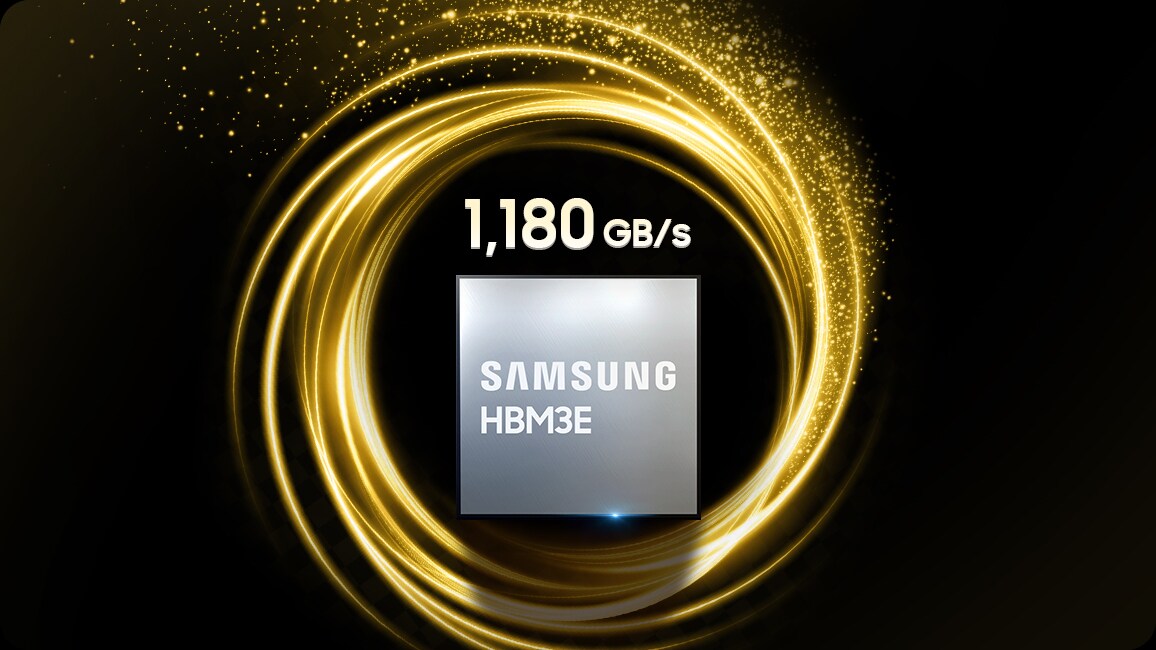
A new era of memory has begun. Samsung’s HBM3E pushes the boundaries of high-performance memory with its advanced 12-layer stack. As the fifth generation of HBM, HBM3E delivers lightning-fast speeds. Its 12-layer stack offers up to 1,180GB/s bandwidth at 9.2Gbps, enabling robust performance for demanding workloads. Its scalability ensures it becomes a cornerstone for AI-driven innovation.
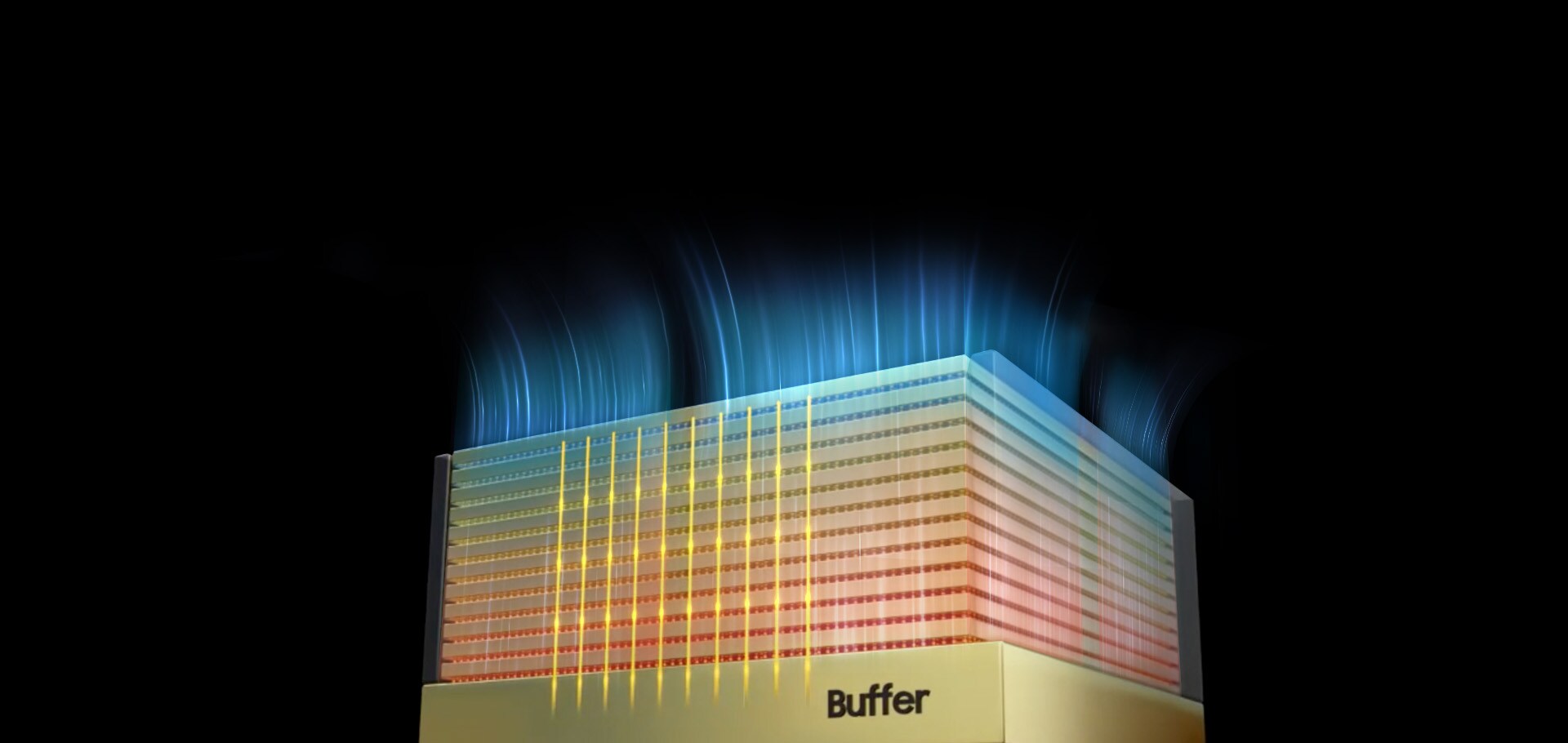
HBM3E boasts a 11% improvement in thermal resistance compared to its predecessor, thanks to its advanced thermal compression non-conductive film(advanced TC NCF) technology. Stacking chips generates heat. To ensure efficient heat dissipation while maintaining strong signal connections between stacked chips, the bumps are strategically designed to be small where signal connection is needed and large where heat dissipation is required. *TC NCF : Thermal Compression - Non-Conductive Film

Support a wider range of applications

Specific timelines for HBM4 approval or customer qualification have not been publicly disclosed.
Any updates or schedule-related information will be shared through official communication channels when available.
Specific timelines for HBM4 approval or customer qualification
have not been publicly disclosed. Any updates or schedule-related information
will be shared through official communication channels when available.
Specific timelines for HBM4 approval or customer qualification have not been publicly disclosed. Any updates or schedule-related information will be shared through official communication
channels when available.
HBM4E enhances bandwidth through further optimization of signaling architecture, channel design, and data transfer efficiency.
These improvements reduce signal loss and enable higher throughput within the same physical footprint.
(Note: The specifics vary by vendor and have not been officially announced.)
HBM4E enhances bandwidth through further optimization of signaling architecture,
channel design, and data transfer efficiency. These improvements reduce signal loss
and enable higher throughput within the same physical footprint.
(Note: The specifics vary by vendor and have not been officially announced.)
HBM4E enhances bandwidth through further optimization of signaling architecture, channel design, and data transfer efficiency. These improvements reduce signal loss and enable higher throughput within the same physical footprint. (Note: The specifics vary by vendor and have not been officially announced.)
Samsung is preparing to adopt Hybrid Copper Bonding (HCB) aligned with the JEDEC standard.
The industry trend is moving toward HCB-based interconnects, although implementation details may vary by vendor.
Samsung is preparing to adopt Hybrid Copper Bonding (HCB) aligned with the JEDEC standard.
The industry trend is moving toward HCB-based interconnects,
although implementation details may vary by vendor.
Samsung is preparing to adopt Hybrid Copper Bonding (HCB) aligned with the JEDEC standard. The industry trend is moving toward HCB-based interconnects, although implementation details
may vary by vendor.
HCB (Hybrid Copper Bonding) is expected to become one of the key mechanisms for future high-performance packaging.
Cu-to-Cu direct bonding enables low resistance, lower dielectric impact, and higher interconnect reliability,
making it highly suitable for advanced, high-density applications.
HCB (Hybrid Copper Bonding) is expected to become one of the key mechanisms
for future high-performance packaging. Cu-to-Cu direct bonding enables low resistance,
lower dielectric impact, and higher interconnect reliability,
making it highly suitable for advanced, high-density applications.
HCB (Hybrid Copper Bonding) is expected to become one of the key mechanisms for future high-performance packaging. Cu-to-Cu direct bonding enables low resistance, lower dielectric impact, and higher interconnect reliability, making it highly suitable for advanced, high-density applications.
HCB is a highly precise Cu-to-Cu bonding process that is sensitive to even microscopic particles or vibrations.
Stable thermal control, vibration isolation, and strict cleanroom environments are essential
to prevent bonding defects and ensure consistent manufacturing quality.
HCB is a highly precise Cu-to-Cu bonding process
that is sensitive to even microscopic particles or vibrations.
Stable thermal control, vibration isolation,
and strict cleanroom environments are essential
to prevent bonding defects and ensure consistent manufacturing quality.
HCB is a highly precise Cu-to-Cu bonding process that is sensitive to even microscopic particles or vibrations. Stable thermal control, vibration isolation, and strict cleanroom environments are essential to prevent bonding defects and ensure consistent manufacturing quality.
Yes. Because HCB does not use bumps, no flux is required, and the process is inherently flux-less.
Yes. Because HCB does not use bumps, no flux is required,
and the process is inherently flux-less.
Yes. Because HCB does not use bumps, no flux is required, and the process is inherently flux-less.
In HCB, effective thermal dissipation is critical due to dense Cu-Cu interconnects.
Precise gap control, optimized insulating layers,
and heat-spreading design are used to maintain electrical reliability and thermal stability.
For NCF, the film helps maintain uniform bonding pressure while supporting thermal and electrical isolation.
In HCB, effective thermal dissipation is critical due to dense Cu-Cu interconnects.
Precise gap control, optimized insulating layers,
and heat-spreading design are used to maintain electrical reliability and thermal stability.
For NCF, the film helps maintain uniform bonding pressure
while supporting thermal and electrical isolation.
In HCB, effective thermal dissipation is critical due to dense Cu-Cu interconnects.
Precise gap control, optimized insulating layers, and heat-spreading design are used to maintain electrical reliability and thermal stability.
For NCF, the film helps maintain uniform bonding pressure while supporting thermal and electrical isolation.
NCF (Non-Conductive Film) uses an insulating adhesive film to press and bond chips together,
while electrical conduction occurs through separate micro-bumps.
In contrast, HCB (Hybrid Copper Bonding) uses direct Cu-to-Cu bonding
that provides both electrical interconnection and mechanical attachment at the same time.
In short, NCF is an insulating adhesive-based method,
whereas HCB is a metal-to-metal direct bonding method optimized for high-speed and high-density packaging.
NCF (Non-Conductive Film) uses an insulating adhesive film to press and bond chips together,
while electrical conduction occurs through separate micro-bumps.
In contrast, HCB (Hybrid Copper Bonding) uses direct Cu-to-Cu bonding
that provides both electrical interconnection and mechanical attachment at the same time.
In short, NCF is an insulating adhesive-based method,
whereas HCB is a metal-to-metal direct bonding method
optimized for high-speed and high-density packaging.
NCF (Non-Conductive Film) uses an insulating adhesive film to press and bond chips together, while electrical conduction occurs through separate micro-bumps.
In contrast, HCB (Hybrid Copper Bonding) uses direct Cu-to-Cu bonding that provides both electrical interconnection and mechanical attachment at the same time.
In short, NCF is an insulating adhesive-based method, whereas HCB is a metal-to-metal direct bonding method optimized for high-speed and high-density packaging.
HCB enables high-speed signal transmission through low-resistance, low-dielectric Cu-to-Cu interconnects.
It also supports high-density stacking, thanks to its thin and precise bonding structure,
making it well-suited for advanced HBM architectures.
In addition, HCB is a flux-less process, improving long-term reliability and reducing defects caused by flux residue.
HCB enables high-speed signal transmission through low-resistance,
low-dielectric Cu-to-Cu interconnects. It also supports high-density stacking,
thanks to its thin and precise bonding structure,
making it well-suited for advanced HBM architectures.
In addition, HCB is a flux-less process,
improving long-term reliability and reducing defects caused by flux residue.
HCB enables high-speed signal transmission through low-resistance, low-dielectric Cu-to-Cu interconnects. It also supports high-density stacking, thanks to its thin and precise bonding structure, making it well-suited for advanced HBM architectures.
In addition, HCB is a flux-less process, improving long-term reliability and reducing defects caused by flux residue.
HCB (Hybrid Copper Bonding) is a bump-less Cu-to-Cu direct bonding technology that simultaneously provides
electrical and mechanical interconnection.
It enables ultra-fine-pitch, high-performance, and high-density 3D packaging.
HCB (Hybrid Copper Bonding) is a bump-less Cu-to-Cu direct bonding technology
that simultaneously provides electrical and mechanical interconnection.
It enables ultra-fine-pitch, high-performance, and high-density 3D packaging.
HCB (Hybrid Copper Bonding) is a bump-less Cu-to-Cu direct bonding technology that simultaneously provides electrical and mechanical interconnection.
It enables ultra-fine-pitch, high-performance, and high-density 3D packaging.

Evolution of semiconductor solutions for servers

 Global