Smartphone cameras have evolved far beyond simple tools for capturing moments. Today, users want to frame an entire landscape during travel, then zoom in to clearly see the windows of a distant building. Whether shooting in daylight or at night, indoors or outdoors, against strong backlight or in motion, users expect their smartphone cameras to reproduce scenes exactly as they see them.
Amid these changing expectations, “200-Megapixel” has emerged as a new benchmark in the smartphone camera market. Higher resolution enables richer detail, greater cropping flexibility, and an entirely new zoom experience. But ultra-high-resolution image sensors are not defined by megapixel count alone. What truly matters is how efficiently ultra-small pixels can capture light and how naturally that performance can be maintained across real-world shooting conditions.
That is why not all ultra-high-resolution image sensors deliver the same experience. While some sensors may achieve impressive detail in bright environments, limitations often appear in more challenging conditions such as low light or zoom photography. Ultimately, a true 200MP experience is determined not only by the number itself, but by the level of technological sophistication behind the pixel structure, algorithms, and overall system design.
Beginning with ISOCELL HP1, the industry’s first 200MP image sensor introduced in 2021, Samsung has led the era of ultra-high-resolution image sensors. From ISOCELL HP1 to ISOCELL HP5 with its industry-first 0.5㎛ pixels in 2025, Samsung System LSI has continued to drive innovation beyond the megapixel race — focusing instead on delivering meaningful user experiences. Now, let us take a closer look at how ultra-high-resolution image sensors optimize image quality across different shooting environments, and what technologies make a true 200MP experience possible.
One of the greatest challenges in ultra-high-resolution image sensors is reduced sensitivity caused by smaller pixels. Since mobile image sensors cannot grow indefinitely in size, increasing the number of pixels inevitably requires shrinking pixel dimensions, which naturally reduces the area available for capturing light. As a result, simply increasing megapixels may produce sharp images in bright conditions, but can also lead to increased noise and loss of detail in low-light environments.
To overcome these limitations, Samsung System LSI has continuously advanced remosaic and pixel binning technologies. These technologies dynamically adapt pixel operation depending on the amount of light in a scene. In bright environments, the sensor operates in ultra-high-resolution mode to maximize detail, while in darker conditions, multiple pixels work together through pixel binning to capture more light.
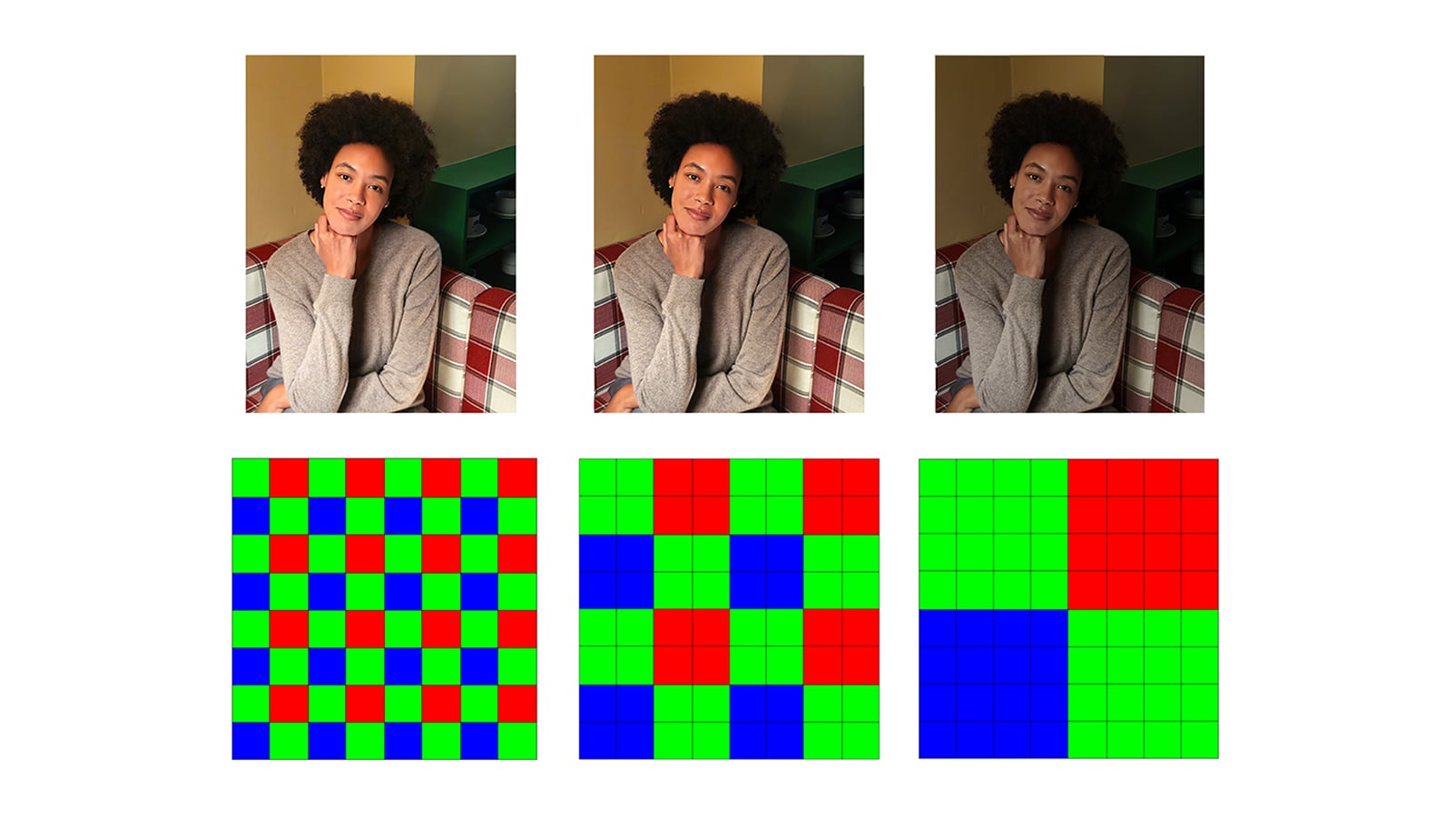
In particular, the Tetra²pixel technology used in Samsung’s 200MP image sensors combines up to 16 adjacent pixels into one, significantly improving low-light performance. As shown in the image above, the sensor operates in full 200MP mode in bright environments to preserve maximum detail, while under low-light conditions, 16 pixels merge together to function as a 12.5MP sensor. In other words, a single image sensor can behave like multiple cameras with different characteristics depending on the shooting environment. As a result, users can enjoy both ultra-high-resolution detail and enhanced low-light performance from a single image sensor.
For many users, zoom is one of the most important aspects of the smartphone camera experience. There are countless moments when users want to zoom into a distant building in a landscape shot or clearly capture a performer far away on stage.
In conventional smartphones, digital zoom inevitably resulted in image quality degradation because it simply cropped and enlarged a portion of the sensor area. Separate telephoto cameras were introduced to address this issue, but differences in sensor size and limited resolution often resulted in inconsistent image quality compared to the main camera.
Samsung’s 200MP ISOCELL image sensors, however, are breaking down the boundaries between wide-angle and telephoto photography through advanced remosaic and ultra-high-resolution technologies that support up to 4x in-sensor zoom.
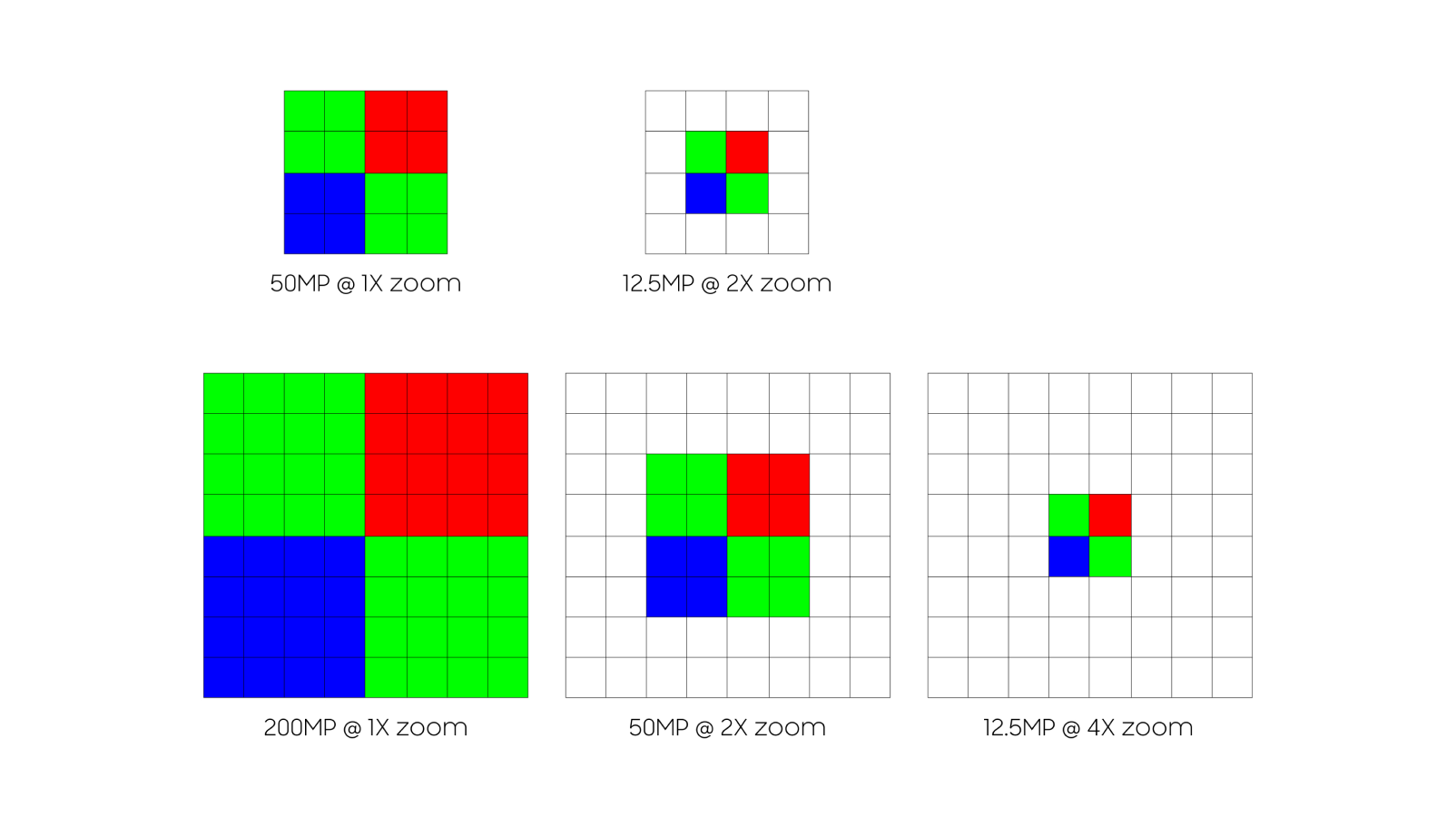
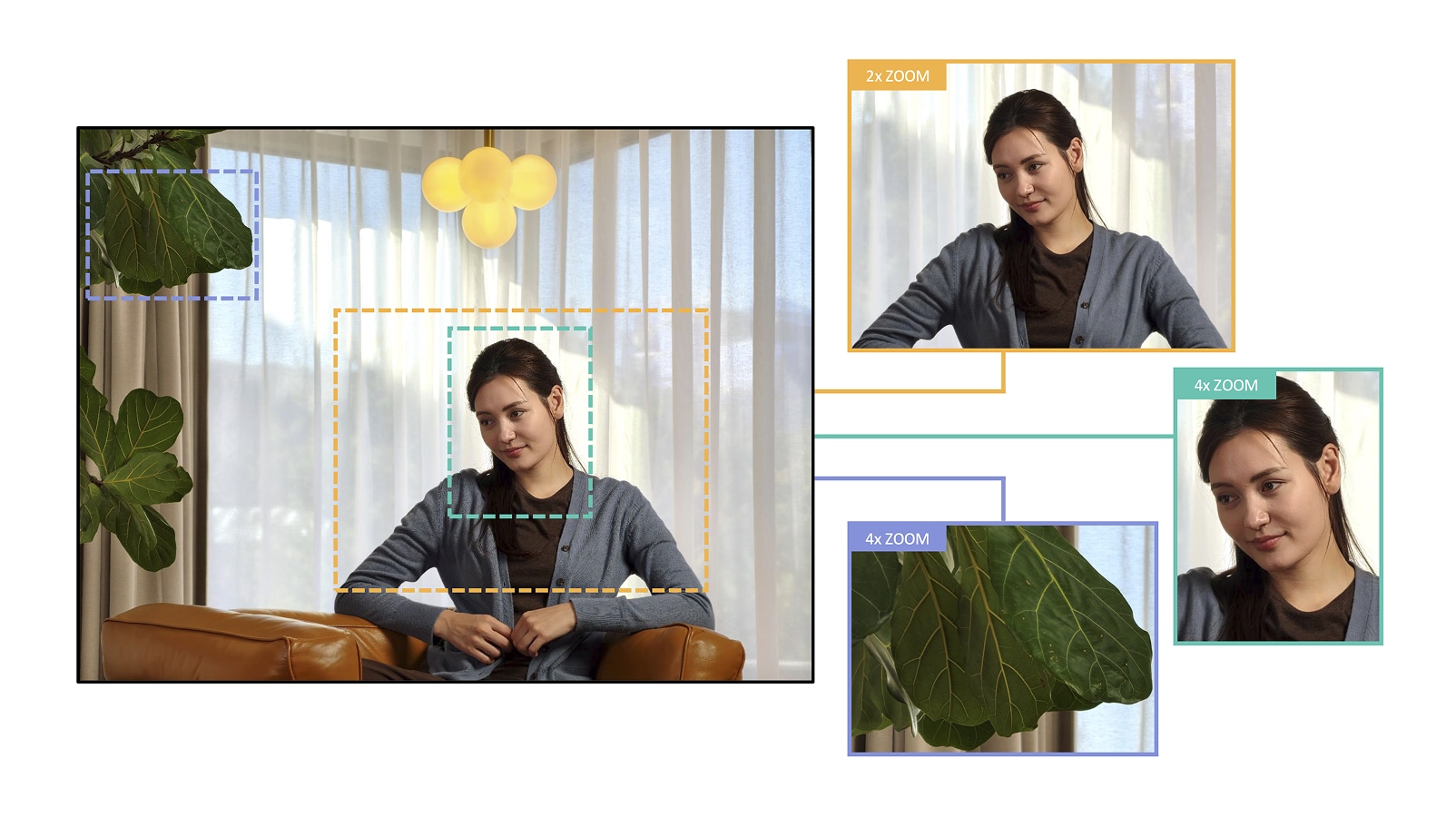
The key lies not in simple cropping, but in preserving sufficient resolution even after zooming by utilizing ultra-high-resolution image data. While conventional 50MP image sensors are typically limited to maintaining 12.5MP resolution at 2x zoom, Samsung’s 200MP image sensors can maintain 12.5MP resolution all the way up to 4x zoom. This means users can experience image quality comparable to a native wide-angle camera across zoom levels from 1x to 4x using in-sensor zoom alone.
As a result, users can first capture an entire wide-angle scene and later crop into any desired area while still retaining high-resolution detail. In-sensor zoom is not simply about enlarging distant subjects — it creates an entirely new photography experience, allowing users to freely expand their perspective within the same scene.
There was once a widespread belief across the industry that shrinking pixels would inevitably lead to poorer image quality. Today, the competitiveness of ultra-high-resolution image sensors depends on how effectively this limitation can be overcome. In other words, the key lies in enabling ultra-fine pixels to capture light efficiently while consistently delivering high image quality.
Since launching ISOCELL HP1 in 2021 and ushering in the era of 200MP image sensors, Samsung System LSI has continued to advance pixel miniaturization from 0.7㎛ to 0.64㎛, then to 0.56㎛ and ultimately 0.5㎛ pixels — maintaining leadership in ultra-fine pixel technology. This achievement was made possible not simply by shrinking pixels, but by introducing new structures, materials, high-sensitivity processes, and advanced optical design technologies that enable stable performance even at extremely small pixel sizes. In recognition of these innovations, Samsung also received a CES 2026 Innovation Awards in the Imaging category.
Ultra-high-resolution sensors are now evolving beyond simple “high-resolution cameras” and fundamentally transforming the smartphone camera experience itself. They are eliminating the traditional boundaries between wide-angle and telephoto photography while enabling thinner smartphone designs with high-magnification zoom capabilities. Users can now enjoy richer and more flexible photography experiences without carrying a separate camera.
A true 200MP experience is not simply about numbers. It is about preserving detail in every environment, maintaining clarity even when zoomed, and capturing light faithfully even in darkness — all within a single compact image sensor.
Ultimately, the essence of ultra-high-resolution competition lies not in how many pixels can be packed into a sensor, but in how completely the imaging experience can be realized. Moving forward, Samsung will continue to lead image sensor innovation through advancements in ultra-high-resolution sensors, 200MP technologies, and ultra-fine pixels — enabling users to capture every moment exactly as they see it, with greater clarity than ever before.

 Global